{"title":"Mn-doping ensuring cobalt silicate hollow spheres with boosted electrochemical property for hybrid supercapacitors","authors":"Chongtao Ding, Yang Wang, Yu Wang, Xueying Dong, Changgong Meng, Yifu Zhang","doi":"10.1002/bte2.20230042","DOIUrl":null,"url":null,"abstract":"<p>Recently, transition metal silicates (TMSs) have garnered significant attention as promising candidates for electrode materials in supercapacitors (SCs), especially cobalt silicate (Co<sub>2</sub>SiO<sub>4</sub>, CoSi) related materials. However, due to the poor conductivity and narrow potential range of CoSi, its electrochemical properties are not fully developed and far from desirable. Herein, to enhance the electrochemical properties of CoSi, hollow spheres of Mn-doped CoSi (CoMnSi) were fabricated through a hydrothermal method. The dopant Mn facilitates the formation of CoMnSi hollow spheres assembled by nanosheets and these nanosheets connect with each other to form the core-shell hollow architecture. The effect of the Mn/Co ratio on the electrochemical properties of CoSi has been investigated. CoMnSi-2 (Mn/Co = 1/9) displays the specific capacitance of 495 F g<sup>−1</sup> at 0.5 A g<sup>−1</sup>, surpassing to that of CoSi (279 F g<sup>−1</sup> at 0.5 A g<sup>−1</sup>) and manganese silicate (denoted as MnSi, 38 F g<sup>−1</sup> at 0.5 A g<sup>−1</sup>). The CoMnSi-2//active carbon hybrid supercapacitor (CoMnSi-2//AC HSC) achieves the specific capacitance with 181 mF cm<sup>−2</sup> (151 F g<sup>−1</sup>) at 1 mA cm<sup>−2</sup> and energy density with 0.644 Wh m<sup>−2</sup> at 2 W m<sup>−2</sup>. The device displays a practical application by powering the LED lamp circuit bulb working for more than 25 min repeatedly. The performance achieved by CoMnSi is superior to some state-of-the-art electrode materials of TMSs. Density functional theory calculations have provided evidence that Mn-doping enhances the electronic conductivity and reduces the electron transport barrier of CoSi, boosting its electrochemical properties. This work supplies a strategy for tailoring structures of TMSs to enhance their electrochemical performance.</p>","PeriodicalId":8807,"journal":{"name":"Battery Energy","volume":"2 6","pages":""},"PeriodicalIF":0.0000,"publicationDate":"2023-10-28","publicationTypes":"Journal Article","fieldsOfStudy":null,"isOpenAccess":false,"openAccessPdf":"https://onlinelibrary.wiley.com/doi/epdf/10.1002/bte2.20230042","citationCount":"0","resultStr":null,"platform":"Semanticscholar","paperid":null,"PeriodicalName":"Battery Energy","FirstCategoryId":"1085","ListUrlMain":"https://onlinelibrary.wiley.com/doi/10.1002/bte2.20230042","RegionNum":0,"RegionCategory":null,"ArticlePicture":[],"TitleCN":null,"AbstractTextCN":null,"PMCID":null,"EPubDate":"","PubModel":"","JCR":"","JCRName":"","Score":null,"Total":0}
引用次数: 0
Abstract
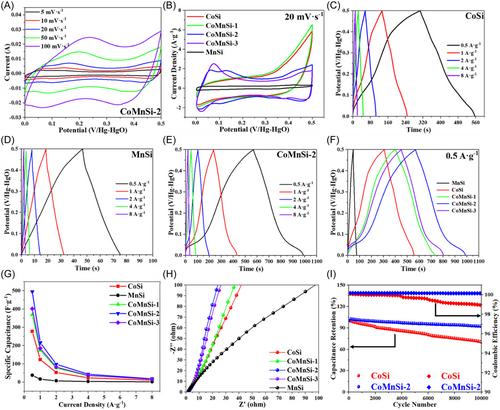
Recently, transition metal silicates (TMSs) have garnered significant attention as promising candidates for electrode materials in supercapacitors (SCs), especially cobalt silicate (Co2SiO4, CoSi) related materials. However, due to the poor conductivity and narrow potential range of CoSi, its electrochemical properties are not fully developed and far from desirable. Herein, to enhance the electrochemical properties of CoSi, hollow spheres of Mn-doped CoSi (CoMnSi) were fabricated through a hydrothermal method. The dopant Mn facilitates the formation of CoMnSi hollow spheres assembled by nanosheets and these nanosheets connect with each other to form the core-shell hollow architecture. The effect of the Mn/Co ratio on the electrochemical properties of CoSi has been investigated. CoMnSi-2 (Mn/Co = 1/9) displays the specific capacitance of 495 F g−1 at 0.5 A g−1, surpassing to that of CoSi (279 F g−1 at 0.5 A g−1) and manganese silicate (denoted as MnSi, 38 F g−1 at 0.5 A g−1). The CoMnSi-2//active carbon hybrid supercapacitor (CoMnSi-2//AC HSC) achieves the specific capacitance with 181 mF cm−2 (151 F g−1) at 1 mA cm−2 and energy density with 0.644 Wh m−2 at 2 W m−2. The device displays a practical application by powering the LED lamp circuit bulb working for more than 25 min repeatedly. The performance achieved by CoMnSi is superior to some state-of-the-art electrode materials of TMSs. Density functional theory calculations have provided evidence that Mn-doping enhances the electronic conductivity and reduces the electron transport barrier of CoSi, boosting its electrochemical properties. This work supplies a strategy for tailoring structures of TMSs to enhance their electrochemical performance.
近年来,过渡金属硅酸盐(tms)作为超级电容器(SCs)中极具潜力的电极材料,尤其是硅酸钴(Co 2 sio4, CoSi)相关材料引起了人们的广泛关注。然而,由于CoSi的导电性差,电势范围窄,其电化学性能没有得到充分的开发,远远达不到理想的程度。为了提高CoSi的电化学性能,采用水热法制备了Mn掺杂CoSi (CoMnSi)空心球。掺杂剂Mn有助于形成由纳米片组装的CoMnSi空心球,这些纳米片相互连接形成核壳空心结构。研究了锰钴比对CoSi电化学性能的影响。CoMnSi‐2 (Mn/Co = 1/9)在0.5 A g−1时的比电容为495 F g−1,超过了CoSi (0.5 A g−1时279 F g−1)和硅酸锰(表示为MnSi, 0.5 A g−1时38 F g−1)。CoMnSi‐2//活性炭混合超级电容器(CoMnSi‐2//AC HSC)在1ma cm−2时的比电容为181 mF cm−2 (151 F g−1),在2w m−2时的能量密度为0.644 Wh m−2。该装置通过给LED灯电路灯泡通电反复工作25分钟以上,显示了实际应用。CoMnSi所取得的性能优于一些最先进的tms电极材料。密度泛函理论计算提供了证据,证明Mn掺杂提高了CoSi的电子导电性,降低了电子传递势垒,提高了其电化学性能。这项工作为调整tms结构以提高其电化学性能提供了一种策略。




 京公网安备 11010802042870号
京ICP备2023020795号-1
京公网安备 11010802042870号
京ICP备2023020795号-1
 分享
分享

 求助内容:
求助内容: 应助结果提醒方式:
 扫码关注我们