Karen Walker-Bone, Melissa A Goodwin, Brent Bufton, Brett Andrew Davis, Henry Wong, Justin Harvey, Sue Barker, Elizabeth Chalker, Sonja Klebe, Sarita Prabhakaran, Fraser J H Brims, Ewan MacFarlane, Geza Benke, Kathleen Mahoney, Timothy R Driscoll
{"title":"Mesothelioma Incidence Rates in Australia since 1982: Exploring Age, Period, and Cohort Effects and Future Projections.","authors":"Karen Walker-Bone, Melissa A Goodwin, Brent Bufton, Brett Andrew Davis, Henry Wong, Justin Harvey, Sue Barker, Elizabeth Chalker, Sonja Klebe, Sarita Prabhakaran, Fraser J H Brims, Ewan MacFarlane, Geza Benke, Kathleen Mahoney, Timothy R Driscoll","doi":"10.1158/1055-9965.EPI-24-1224","DOIUrl":null,"url":null,"abstract":"<p><strong>Background: </strong>The use of asbestos-containing products was banned in Australia in 2003. However, the rates of new cases of mesothelioma, which has a very long latent period between exposure and disease, have continued to increase. The aim of this study was to investigate mesothelioma incidence in Australia by year of birth and age-period-cohort analysis and to develop projections of expected mesothelioma cases until 2034.</p><p><strong>Methods: </strong>Data were derived from the Australian Cancer Database which provides complete national records of mesothelioma cases notified between 1982 and 2020. Incidence rates were age-standardized to the 2001 Australian standard population to enable comparisons of the population across time. Age-period-cohort models were used to examine the temporal trends of incidence rates by age, calendar year, and birth cohort. Projections for incidence rates of mesothelioma for 2020 to 2034 were estimated using Nordpred models.</p><p><strong>Results: </strong>Graphs of age-standardized incidence rates of mesothelioma suggest a birth cohort effect, and the age-period-cohort model confirmed this. There was a birth cohort effect in all cohorts born before 1960, strongest in cohorts born during 1920 to 1949. Projection modeling to 2034 suggested that the age-standardized rates will continue to decline whereas crude incidence rates of mesothelioma will stabilize and then gradually decline, mostly among people of 60 to 84 years of age.</p><p><strong>Conclusions: </strong>The findings are consistent with the greatest risk of mesothelioma in Australia occurring in cohorts with the highest levels of historical cumulative occupational exposure, showing the value of a ban on asbestos.</p><p><strong>Impact: </strong>The number of new cases of mesothelioma per year is not expected to decline until after 2030.</p>","PeriodicalId":9458,"journal":{"name":"Cancer Epidemiology Biomarkers & Prevention","volume":" ","pages":"1149-1155"},"PeriodicalIF":3.7000,"publicationDate":"2025-07-01","publicationTypes":"Journal Article","fieldsOfStudy":null,"isOpenAccess":false,"openAccessPdf":"https://www.ncbi.nlm.nih.gov/pmc/articles/PMC12209811/pdf/","citationCount":"0","resultStr":null,"platform":"Semanticscholar","paperid":null,"PeriodicalName":"Cancer Epidemiology Biomarkers & Prevention","FirstCategoryId":"3","ListUrlMain":"https://doi.org/10.1158/1055-9965.EPI-24-1224","RegionNum":3,"RegionCategory":"医学","ArticlePicture":[],"TitleCN":null,"AbstractTextCN":null,"PMCID":null,"EPubDate":"","PubModel":"","JCR":"Q2","JCRName":"ONCOLOGY","Score":null,"Total":0}
引用次数: 0
Abstract
Background: The use of asbestos-containing products was banned in Australia in 2003. However, the rates of new cases of mesothelioma, which has a very long latent period between exposure and disease, have continued to increase. The aim of this study was to investigate mesothelioma incidence in Australia by year of birth and age-period-cohort analysis and to develop projections of expected mesothelioma cases until 2034.
Methods: Data were derived from the Australian Cancer Database which provides complete national records of mesothelioma cases notified between 1982 and 2020. Incidence rates were age-standardized to the 2001 Australian standard population to enable comparisons of the population across time. Age-period-cohort models were used to examine the temporal trends of incidence rates by age, calendar year, and birth cohort. Projections for incidence rates of mesothelioma for 2020 to 2034 were estimated using Nordpred models.
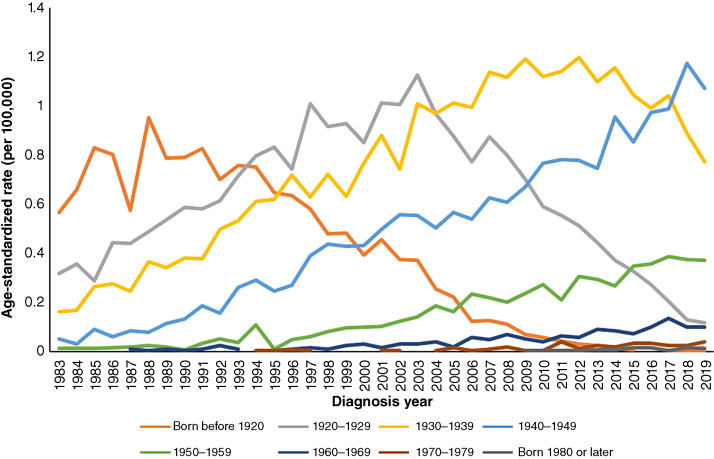
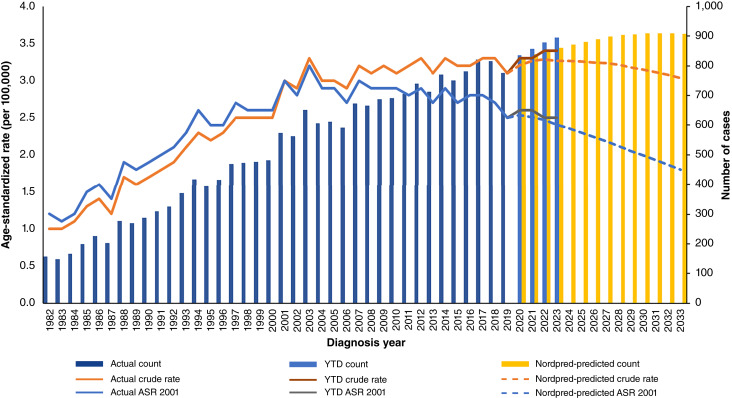
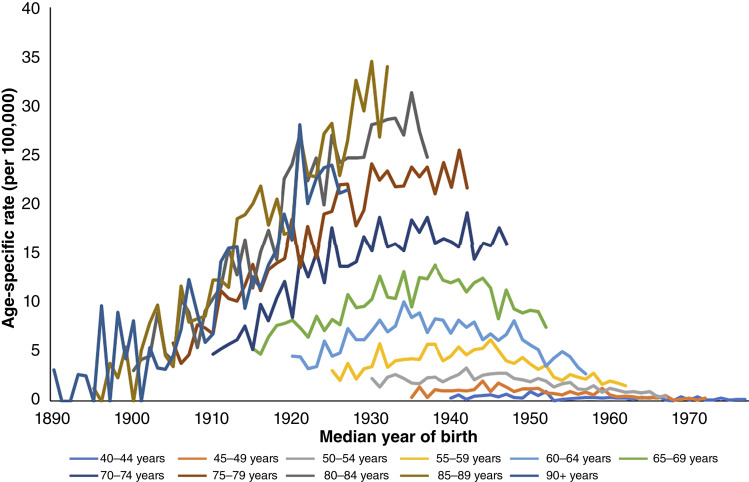
Results: Graphs of age-standardized incidence rates of mesothelioma suggest a birth cohort effect, and the age-period-cohort model confirmed this. There was a birth cohort effect in all cohorts born before 1960, strongest in cohorts born during 1920 to 1949. Projection modeling to 2034 suggested that the age-standardized rates will continue to decline whereas crude incidence rates of mesothelioma will stabilize and then gradually decline, mostly among people of 60 to 84 years of age.
Conclusions: The findings are consistent with the greatest risk of mesothelioma in Australia occurring in cohorts with the highest levels of historical cumulative occupational exposure, showing the value of a ban on asbestos.
Impact: The number of new cases of mesothelioma per year is not expected to decline until after 2030.
期刊介绍:
Cancer Epidemiology, Biomarkers & Prevention publishes original peer-reviewed, population-based research on cancer etiology, prevention, surveillance, and survivorship. The following topics are of special interest: descriptive, analytical, and molecular epidemiology; biomarkers including assay development, validation, and application; chemoprevention and other types of prevention research in the context of descriptive and observational studies; the role of behavioral factors in cancer etiology and prevention; survivorship studies; risk factors; implementation science and cancer care delivery; and the science of cancer health disparities. Besides welcoming manuscripts that address individual subjects in any of the relevant disciplines, CEBP editors encourage the submission of manuscripts with a transdisciplinary approach.





 京公网安备 11010802042870号
京ICP备2023020795号-1
京公网安备 11010802042870号
京ICP备2023020795号-1
 分享
分享
 求助内容:
求助内容: 应助结果提醒方式:
 扫码关注我们