Machine learning-based structural analysis of OATP1B1 interactors/non-interactors: Discriminating toxic and non-toxic alerts for transporter-mediated toxicity
Shovanlal Gayen , Indrasis Dasgupta , Balaram Ghosh , Insaf Ahmed Qureshi , Partha Pratim Roy
{"title":"Machine learning-based structural analysis of OATP1B1 interactors/non-interactors: Discriminating toxic and non-toxic alerts for transporter-mediated toxicity","authors":"Shovanlal Gayen , Indrasis Dasgupta , Balaram Ghosh , Insaf Ahmed Qureshi , Partha Pratim Roy","doi":"10.1016/j.comtox.2025.100373","DOIUrl":null,"url":null,"abstract":"<div><div>This hepatic transporter, OATP1B1, plays a critical role in transporter-related toxic responses and drug-drug interactions (DDIs). Several drug-drug interactions associated with OATP1B1 are clinically reported during combination therapies of lipid-lowering statins with antihypertensive, antiviral, and antibiotic drugs.</div><div>In the present study, different molecular properties of OATP1B1-interactors and non-interactors were initially compared, and the results revealed a distinct pattern in molecular weight, hydrophobicity, and number of rotatable bonds between them. Further chemical space, scaffold content, and diversity analyses indicated that OATP1B1-interactors/non-interactors are structurally diverse. Recursive partitioning and Bayesian classification analyses, involving ECFP and FCFP fingerprints, highlighted critical structural features that may serve as alerts for toxic or non-toxic effects on OATP1B1-mediated toxicity. Other machine learning-based classification models were also constructed, where Support Vector Classifier (SVC) shows higher statistical significance and predictive ability (accuracy: 0.797; precision: 0.833, and recall: 0.758). Moreover, local and global SHAP analyses were also performed to explain the distinctive structural features of OATP1B1-interactors and non-interactors.</div><div>Overall, the study offers insights into structural determinants of OATP1B1 interactions and provides predictive models to distinguish interactors from non-interactors, which may aid in reducing transporter-related toxicity risks in drug development. The outcomes may assist in advancing the safety and performance of medicinal compounds.</div></div>","PeriodicalId":37651,"journal":{"name":"Computational Toxicology","volume":"35 ","pages":"Article 100373"},"PeriodicalIF":2.9000,"publicationDate":"2025-09-01","publicationTypes":"Journal Article","fieldsOfStudy":null,"isOpenAccess":false,"openAccessPdf":"","citationCount":"0","resultStr":null,"platform":"Semanticscholar","paperid":null,"PeriodicalName":"Computational Toxicology","FirstCategoryId":"1085","ListUrlMain":"https://www.sciencedirect.com/science/article/pii/S2468111325000337","RegionNum":0,"RegionCategory":null,"ArticlePicture":[],"TitleCN":null,"AbstractTextCN":null,"PMCID":null,"EPubDate":"2025/8/8 0:00:00","PubModel":"Epub","JCR":"Q2","JCRName":"TOXICOLOGY","Score":null,"Total":0}
引用次数: 0
Abstract
This hepatic transporter, OATP1B1, plays a critical role in transporter-related toxic responses and drug-drug interactions (DDIs). Several drug-drug interactions associated with OATP1B1 are clinically reported during combination therapies of lipid-lowering statins with antihypertensive, antiviral, and antibiotic drugs.
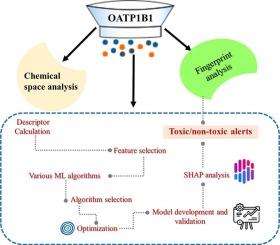
In the present study, different molecular properties of OATP1B1-interactors and non-interactors were initially compared, and the results revealed a distinct pattern in molecular weight, hydrophobicity, and number of rotatable bonds between them. Further chemical space, scaffold content, and diversity analyses indicated that OATP1B1-interactors/non-interactors are structurally diverse. Recursive partitioning and Bayesian classification analyses, involving ECFP and FCFP fingerprints, highlighted critical structural features that may serve as alerts for toxic or non-toxic effects on OATP1B1-mediated toxicity. Other machine learning-based classification models were also constructed, where Support Vector Classifier (SVC) shows higher statistical significance and predictive ability (accuracy: 0.797; precision: 0.833, and recall: 0.758). Moreover, local and global SHAP analyses were also performed to explain the distinctive structural features of OATP1B1-interactors and non-interactors.
Overall, the study offers insights into structural determinants of OATP1B1 interactions and provides predictive models to distinguish interactors from non-interactors, which may aid in reducing transporter-related toxicity risks in drug development. The outcomes may assist in advancing the safety and performance of medicinal compounds.
期刊介绍:
Computational Toxicology is an international journal publishing computational approaches that assist in the toxicological evaluation of new and existing chemical substances assisting in their safety assessment. -All effects relating to human health and environmental toxicity and fate -Prediction of toxicity, metabolism, fate and physico-chemical properties -The development of models from read-across, (Q)SARs, PBPK, QIVIVE, Multi-Scale Models -Big Data in toxicology: integration, management, analysis -Implementation of models through AOPs, IATA, TTC -Regulatory acceptance of models: evaluation, verification and validation -From metals, to small organic molecules to nanoparticles -Pharmaceuticals, pesticides, foods, cosmetics, fine chemicals -Bringing together the views of industry, regulators, academia, NGOs





 京公网安备 11010802042870号
京ICP备2023020795号-1
京公网安备 11010802042870号
京ICP备2023020795号-1
 分享
分享
 求助内容:
求助内容: 应助结果提醒方式:
 扫码关注我们