М M Erokhin, N Y Kozelchuk, R H Ziganshin, V V Tatarskiy, D A Chetverina
{"title":"HOXB13 interactome in prostate cancer cells: biochemical and functional interactions between the transcription factors HOXB13 and TBX3.","authors":"М M Erokhin, N Y Kozelchuk, R H Ziganshin, V V Tatarskiy, D A Chetverina","doi":"10.18699/vjgb-25-82","DOIUrl":null,"url":null,"abstract":"<p><p>Transcription factors represent one of the major groups of proteins, whose suppression leads to tumor growth arrest. Different types of cancer express a specific set of transcription factors that create and maintain unique patterns of gene expression. In prostate cancer cells, one of the key transcriptional regulators is the HOXB13 (Homeobox B13) protein. HOXB13 is known to be an important regulator of embryonic development and terminal cell differentiation. HOXB13 regulates the transcription of many genes in normal and transformed prostate cells and is also capable of acting as a pioneer factor that opens chromatin in the regulatory regions of genes. However, little is known about the protein partners and functions of HOXB13 in prostate cells. In the present study, we searched for protein partners of HOXB13 by immunoaffinity purification followed by high-throughput mass spectrometric analysis (IP/LC-MS) using the PC-3 prostate cancer cell line as a model. The main partners of HOXB13 were found to be transcription factors with different types of DNA-binding domains, including the TBX3, TBX2, ZFHX4, ZFHX3, RUNX1, NFAT5 proteins. Using the DepMap resource, we have shown that one of the identified partners, the TBX3 protein is as critical for the growth and proliferation of prostate cancer cell lines in vitro as HOXB13. Analysis of individual prostate cancer cell lines revealed that knockout of both genes, HOXB13 and TBX3, leads to the death of the same lines: VCaP, LNCaP (clone FGC), PC-3 and 22Rv1. Thus, HOXB13 and TBX3 can be considered together as potential targets for the development of specific inhibitors that suppress prostate cancer cell growth.</p>","PeriodicalId":44339,"journal":{"name":"Vavilovskii Zhurnal Genetiki i Selektsii","volume":"29 6","pages":"744-752"},"PeriodicalIF":1.2000,"publicationDate":"2025-10-01","publicationTypes":"Journal Article","fieldsOfStudy":null,"isOpenAccess":false,"openAccessPdf":"https://www.ncbi.nlm.nih.gov/pmc/articles/PMC12559696/pdf/","citationCount":"0","resultStr":null,"platform":"Semanticscholar","paperid":null,"PeriodicalName":"Vavilovskii Zhurnal Genetiki i Selektsii","FirstCategoryId":"1085","ListUrlMain":"https://doi.org/10.18699/vjgb-25-82","RegionNum":0,"RegionCategory":null,"ArticlePicture":[],"TitleCN":null,"AbstractTextCN":null,"PMCID":null,"EPubDate":"","PubModel":"","JCR":"Q3","JCRName":"AGRICULTURE, MULTIDISCIPLINARY","Score":null,"Total":0}
引用次数: 0
Abstract
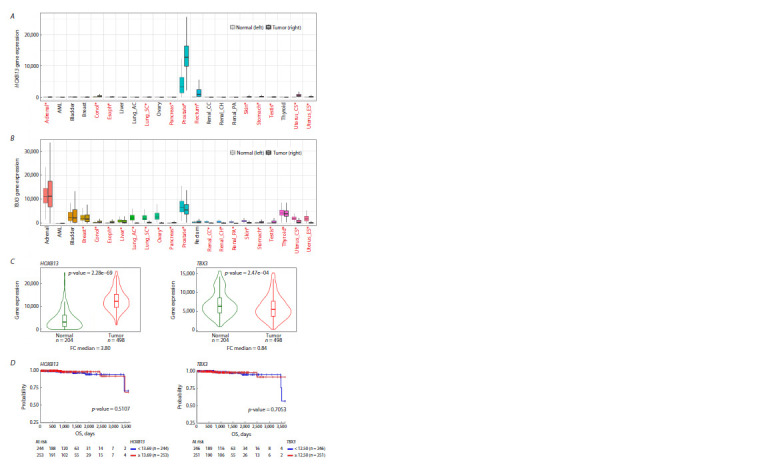
Transcription factors represent one of the major groups of proteins, whose suppression leads to tumor growth arrest. Different types of cancer express a specific set of transcription factors that create and maintain unique patterns of gene expression. In prostate cancer cells, one of the key transcriptional regulators is the HOXB13 (Homeobox B13) protein. HOXB13 is known to be an important regulator of embryonic development and terminal cell differentiation. HOXB13 regulates the transcription of many genes in normal and transformed prostate cells and is also capable of acting as a pioneer factor that opens chromatin in the regulatory regions of genes. However, little is known about the protein partners and functions of HOXB13 in prostate cells. In the present study, we searched for protein partners of HOXB13 by immunoaffinity purification followed by high-throughput mass spectrometric analysis (IP/LC-MS) using the PC-3 prostate cancer cell line as a model. The main partners of HOXB13 were found to be transcription factors with different types of DNA-binding domains, including the TBX3, TBX2, ZFHX4, ZFHX3, RUNX1, NFAT5 proteins. Using the DepMap resource, we have shown that one of the identified partners, the TBX3 protein is as critical for the growth and proliferation of prostate cancer cell lines in vitro as HOXB13. Analysis of individual prostate cancer cell lines revealed that knockout of both genes, HOXB13 and TBX3, leads to the death of the same lines: VCaP, LNCaP (clone FGC), PC-3 and 22Rv1. Thus, HOXB13 and TBX3 can be considered together as potential targets for the development of specific inhibitors that suppress prostate cancer cell growth.
期刊介绍:
The "Vavilov Journal of genetics and breeding" publishes original research and review articles in all key areas of modern plant, animal and human genetics, genomics, bioinformatics and biotechnology. One of the main objectives of the journal is integration of theoretical and applied research in the field of genetics. Special attention is paid to the most topical areas in modern genetics dealing with global concerns such as food security and human health.







 京公网安备 11010802042870号
京ICP备2023020795号-1
京公网安备 11010802042870号
京ICP备2023020795号-1
 分享
分享
 求助内容:
求助内容: 应助结果提醒方式:
 扫码关注我们