The Impact of Diagnostic Delays and Timeliness of Response on Ebola Disease outbreak-level case-fatality Ratios in Uganda (2000-2023): a Rapid Systematic Review and meta-analysis.
{"title":"The Impact of Diagnostic Delays and Timeliness of Response on Ebola Disease outbreak-level case-fatality Ratios in Uganda (2000-2023): a Rapid Systematic Review and meta-analysis.","authors":"George Paasi, Sam Okware, Peter Olupot-Olupot","doi":"10.1007/s44197-025-00471-1","DOIUrl":null,"url":null,"abstract":"<p><strong>Background: </strong>Uganda has experienced seven laboratory-confirmed Ebola virus disease (EBOD) outbreaks from 2000 to 2022, with reported case-fatality ratios (CFRs) varying widely. The influence of diagnostic and response delays on outbreak-level mortality has not been systematically assessed. We conducted a rapid systematic review and meta-analysis to quantify the effect of diagnostic and response delays on outbreak-level mortality.</p><p><strong>Methods: </strong>We registered the review on OSF and adhered to PRISMA-2020 guidelines. We searched PubMed, Embase, Scopus, Web of Science, WHO Global Index Medicus, and grey literature through 30 April 2025. Eligible reports described laboratory-confirmed human EBOD in Uganda (2000-2022) and reported case counts, deaths, or quantitative timeliness metrics. Outbreak-level CFRs were meta-analyzed using random-effects models with Freeman-Tukey transformation (metafor package in R). Mixed-effects meta-regression assessed the association between continuous delay metrics and transformed CFR.</p><p><strong>Results: </strong>Fifteen reports met inclusion criteria, spanning 741 confirmed cases and 358 deaths. The pooled CFR was 45.4% (95% CI: 26.2%-65.2%; I² = 87.8%) across seven outbreaks. By species, Sudan ebolavirus outbreaks (n = 5) had a CFR of 44.6% (95% CI: 33.7%-55.6%), Bundibugyo ebolavirus (n = 1) 24.8% (95% CI: 18.2%-32.1%), and Zaire ebolavirus (n = 1) 100% (95% CI: 61.2%-100.0%). In meta-regression, each additional day from first case report to specimen collection was associated with a significant increase in CFR (β = 0.142 on the transformed scale; p = 0.025; R² = 62%), translating to an approximate absolute increase of 3.8% points in CFR per day at a baseline risk of 45%. Conversely, longer delays from symptom onset in the index case to national outbreak declaration were linked to a slight decrease in CFR (β = - 0.00765; p = 0.047).</p><p><strong>Conclusions: </strong>Uganda's EBOD outbreaks exhibit high and variable mortality, with diagnostic delays substantially amplifying case-fatality. Rapid specimen collection and prompt public health responses are critical to reducing EBOD mortality. Strengthening laboratory networks and accelerating declaration protocols should be central to future outbreak preparedness in Uganda and similar contexts.</p>","PeriodicalId":15796,"journal":{"name":"Journal of Epidemiology and Global Health","volume":"15 1","pages":"130"},"PeriodicalIF":3.1000,"publicationDate":"2025-11-11","publicationTypes":"Journal Article","fieldsOfStudy":null,"isOpenAccess":false,"openAccessPdf":"https://www.ncbi.nlm.nih.gov/pmc/articles/PMC12605935/pdf/","citationCount":"0","resultStr":null,"platform":"Semanticscholar","paperid":null,"PeriodicalName":"Journal of Epidemiology and Global Health","FirstCategoryId":"3","ListUrlMain":"https://doi.org/10.1007/s44197-025-00471-1","RegionNum":4,"RegionCategory":"医学","ArticlePicture":[],"TitleCN":null,"AbstractTextCN":null,"PMCID":null,"EPubDate":"","PubModel":"","JCR":"Q1","JCRName":"PUBLIC, ENVIRONMENTAL & OCCUPATIONAL HEALTH","Score":null,"Total":0}
引用次数: 0
Abstract
Background: Uganda has experienced seven laboratory-confirmed Ebola virus disease (EBOD) outbreaks from 2000 to 2022, with reported case-fatality ratios (CFRs) varying widely. The influence of diagnostic and response delays on outbreak-level mortality has not been systematically assessed. We conducted a rapid systematic review and meta-analysis to quantify the effect of diagnostic and response delays on outbreak-level mortality.
Methods: We registered the review on OSF and adhered to PRISMA-2020 guidelines. We searched PubMed, Embase, Scopus, Web of Science, WHO Global Index Medicus, and grey literature through 30 April 2025. Eligible reports described laboratory-confirmed human EBOD in Uganda (2000-2022) and reported case counts, deaths, or quantitative timeliness metrics. Outbreak-level CFRs were meta-analyzed using random-effects models with Freeman-Tukey transformation (metafor package in R). Mixed-effects meta-regression assessed the association between continuous delay metrics and transformed CFR.
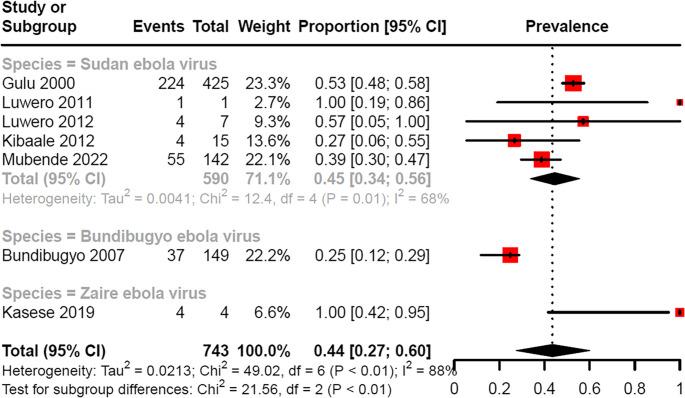
Results: Fifteen reports met inclusion criteria, spanning 741 confirmed cases and 358 deaths. The pooled CFR was 45.4% (95% CI: 26.2%-65.2%; I² = 87.8%) across seven outbreaks. By species, Sudan ebolavirus outbreaks (n = 5) had a CFR of 44.6% (95% CI: 33.7%-55.6%), Bundibugyo ebolavirus (n = 1) 24.8% (95% CI: 18.2%-32.1%), and Zaire ebolavirus (n = 1) 100% (95% CI: 61.2%-100.0%). In meta-regression, each additional day from first case report to specimen collection was associated with a significant increase in CFR (β = 0.142 on the transformed scale; p = 0.025; R² = 62%), translating to an approximate absolute increase of 3.8% points in CFR per day at a baseline risk of 45%. Conversely, longer delays from symptom onset in the index case to national outbreak declaration were linked to a slight decrease in CFR (β = - 0.00765; p = 0.047).
Conclusions: Uganda's EBOD outbreaks exhibit high and variable mortality, with diagnostic delays substantially amplifying case-fatality. Rapid specimen collection and prompt public health responses are critical to reducing EBOD mortality. Strengthening laboratory networks and accelerating declaration protocols should be central to future outbreak preparedness in Uganda and similar contexts.
期刊介绍:
The Journal of Epidemiology and Global Health is an esteemed international publication, offering a platform for peer-reviewed articles that drive advancements in global epidemiology and international health. Our mission is to shape global health policy by showcasing cutting-edge scholarship and innovative strategies.





 京公网安备 11010802042870号
京ICP备2023020795号-1
京公网安备 11010802042870号
京ICP备2023020795号-1
 分享
分享
 求助内容:
求助内容: 应助结果提醒方式:
 扫码关注我们