Patrick Goodley PhD , Haval Balata PhD , Alberto Alonso LMS , Anna Sharman MBChB , Louise Brown MD , Rehan Naseer MBChB , Haider Al-Najjar MBChB , Zoe Merchant MSc , Kath Hewitt RN , Coral Higgins MSc , Richard Booton PhD , Hilary A. Robbins PhD , Matthew Sperrin PhD , Philip A.J. Crosbie PhD
{"title":"Population Impact of Risk-Based Lung Cancer Screening on Late-Stage Incidence in Greater Manchester","authors":"Patrick Goodley PhD , Haval Balata PhD , Alberto Alonso LMS , Anna Sharman MBChB , Louise Brown MD , Rehan Naseer MBChB , Haider Al-Najjar MBChB , Zoe Merchant MSc , Kath Hewitt RN , Coral Higgins MSc , Richard Booton PhD , Hilary A. Robbins PhD , Matthew Sperrin PhD , Philip A.J. Crosbie PhD","doi":"10.1016/j.jtho.2025.11.014","DOIUrl":null,"url":null,"abstract":"<div><h3>Introduction</h3><div>Low-dose computed tomography screening reduces lung cancer mortality in clinical trials, but evidence of impact in real-world programs is lacking. Here, we evaluate the impact of screening in a socio-economically deprived area at the population level. We hypothesized that late-stage lung cancer incidence, as a surrogate for lung cancer mortality, would decrease after systematic implementation of screening in a high-risk population.</div></div><div><h3>Methods</h3><div>Late-stage lung cancer incidence among individuals aged 55 to 80 years at the time of screening invitation was compared before and after screening implementation between regions with and without implementation of community-based lung cancer screening (North & East Manchester [screening] versus four neighboring regions [no screening]). The effect of screening was estimated using difference-in-difference modeling.</div></div><div><h3>Results</h3><div>Late-stage lung cancer incidence decreased more steeply in the screening region, such that screening was associated with a 22% reduction in late-stage lung cancer incidence among the invited age range of 55 to 80 years (adjusted incidence rate ratio, 0.78; 95% confidence interval, 0.62–0.99; <em>p</em> = 0.037). Targeted low-dose computed tomography screening of 2.0% of the full North & East Manchester population (n = 4468/221,240) detected 31% of all lung cancers diagnosed since screening commenced (n = 221/722), yielding a number-needed-to-screen of 20 for each cancer detected.</div></div><div><h3>Conclusion</h3><div>Implementation of targeted, community-based lung cancer screening in an area of high socioeconomic deprivation was associated with a significant reduction in late-stage lung cancer incidence. This provides a demonstration of screening effectiveness and public health benefit.</div></div>","PeriodicalId":17515,"journal":{"name":"Journal of Thoracic Oncology","volume":"21 4","pages":"Article 103524"},"PeriodicalIF":20.8000,"publicationDate":"2026-04-01","publicationTypes":"Journal Article","fieldsOfStudy":null,"isOpenAccess":false,"openAccessPdf":"","citationCount":"0","resultStr":null,"platform":"Semanticscholar","paperid":null,"PeriodicalName":"Journal of Thoracic Oncology","FirstCategoryId":"3","ListUrlMain":"https://www.sciencedirect.com/science/article/pii/S1556086425029089","RegionNum":1,"RegionCategory":"医学","ArticlePicture":[],"TitleCN":null,"AbstractTextCN":null,"PMCID":null,"EPubDate":"2025/12/2 0:00:00","PubModel":"Epub","JCR":"Q1","JCRName":"ONCOLOGY","Score":null,"Total":0}
引用次数: 0
Abstract
Introduction
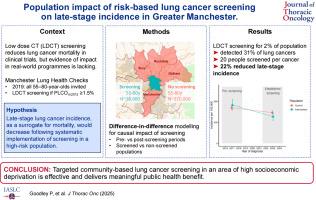
Low-dose computed tomography screening reduces lung cancer mortality in clinical trials, but evidence of impact in real-world programs is lacking. Here, we evaluate the impact of screening in a socio-economically deprived area at the population level. We hypothesized that late-stage lung cancer incidence, as a surrogate for lung cancer mortality, would decrease after systematic implementation of screening in a high-risk population.
Methods
Late-stage lung cancer incidence among individuals aged 55 to 80 years at the time of screening invitation was compared before and after screening implementation between regions with and without implementation of community-based lung cancer screening (North & East Manchester [screening] versus four neighboring regions [no screening]). The effect of screening was estimated using difference-in-difference modeling.
Results
Late-stage lung cancer incidence decreased more steeply in the screening region, such that screening was associated with a 22% reduction in late-stage lung cancer incidence among the invited age range of 55 to 80 years (adjusted incidence rate ratio, 0.78; 95% confidence interval, 0.62–0.99; p = 0.037). Targeted low-dose computed tomography screening of 2.0% of the full North & East Manchester population (n = 4468/221,240) detected 31% of all lung cancers diagnosed since screening commenced (n = 221/722), yielding a number-needed-to-screen of 20 for each cancer detected.
Conclusion
Implementation of targeted, community-based lung cancer screening in an area of high socioeconomic deprivation was associated with a significant reduction in late-stage lung cancer incidence. This provides a demonstration of screening effectiveness and public health benefit.
期刊介绍:
Journal of Thoracic Oncology (JTO), the official journal of the International Association for the Study of Lung Cancer,is the primary educational and informational publication for topics relevant to the prevention, detection, diagnosis, and treatment of all thoracic malignancies.The readship includes epidemiologists, medical oncologists, radiation oncologists, thoracic surgeons, pulmonologists, radiologists, pathologists, nuclear medicine physicians, and research scientists with a special interest in thoracic oncology.





 京公网安备 11010802042870号
京ICP备2023020795号-1
京公网安备 11010802042870号
京ICP备2023020795号-1
 分享
分享
 求助内容:
求助内容: 应助结果提醒方式:
 扫码关注我们