Bahar Mosanaee, Saba Mazareei, Iliya Fattahiyan, Moein Ziyazadeh, Hamide Ehtesabi
{"title":"Gold nanoparticles for salivary-based sensors: A review","authors":"Bahar Mosanaee, Saba Mazareei, Iliya Fattahiyan, Moein Ziyazadeh, Hamide Ehtesabi","doi":"10.1016/j.ymeth.2025.12.008","DOIUrl":null,"url":null,"abstract":"<div><div>Advancements in nanotechnology integrated with biomedical diagnostics have facilitated substantial progress in non-invasive health monitoring, with salivary biosensors utilizing gold nanoparticles (AuNPs) emerging as a novel approach for rapid, sensitive, and user-friendly point-of-care testing. This review article demonstrates how researchers utilize the distinctive physicochemical qualities of AuNPs, specifically their plasmonic responsiveness and bioconjugation ability, to improve diverse biosensing techniques. Rather than traditional blood-based diagnostics, AuNP-based devices utilize saliva as a molecular reservoir to monitor a variety of biomarkers such as hormones, metabolites, nucleic acids, or other analytes. The development of these biosensors extends beyond technological innovation to their incorporation into affordable, user-friendly devices that address clinical needs. Still, converting these biosensors into standardized health care diagnostic tools encounters similar challenges as other bioassays pertaining to biofluid-based complexity, burden of reproducibility, and regulatory approval. In addition to summarizing the extent of scientific and engineering accomplishments to date, this review highlights the opportunity for future implementation of AuNP-based biosensor tests in personalized medicine, advocating synergistic interdisciplinary approaches that integrate materials science, digital analytics, and device engineering to fully realize AuNP-based salivary diagnostics.</div></div>","PeriodicalId":390,"journal":{"name":"Methods","volume":"246 ","pages":"Pages 195-222"},"PeriodicalIF":4.3000,"publicationDate":"2026-02-01","publicationTypes":"Journal Article","fieldsOfStudy":null,"isOpenAccess":false,"openAccessPdf":"","citationCount":"0","resultStr":null,"platform":"Semanticscholar","paperid":null,"PeriodicalName":"Methods","FirstCategoryId":"99","ListUrlMain":"https://www.sciencedirect.com/science/article/pii/S1046202325002518","RegionNum":3,"RegionCategory":"生物学","ArticlePicture":[],"TitleCN":null,"AbstractTextCN":null,"PMCID":null,"EPubDate":"2025/12/20 0:00:00","PubModel":"Epub","JCR":"Q1","JCRName":"BIOCHEMICAL RESEARCH METHODS","Score":null,"Total":0}
引用次数: 0
Abstract
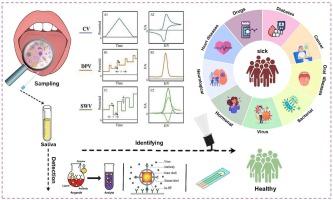
Advancements in nanotechnology integrated with biomedical diagnostics have facilitated substantial progress in non-invasive health monitoring, with salivary biosensors utilizing gold nanoparticles (AuNPs) emerging as a novel approach for rapid, sensitive, and user-friendly point-of-care testing. This review article demonstrates how researchers utilize the distinctive physicochemical qualities of AuNPs, specifically their plasmonic responsiveness and bioconjugation ability, to improve diverse biosensing techniques. Rather than traditional blood-based diagnostics, AuNP-based devices utilize saliva as a molecular reservoir to monitor a variety of biomarkers such as hormones, metabolites, nucleic acids, or other analytes. The development of these biosensors extends beyond technological innovation to their incorporation into affordable, user-friendly devices that address clinical needs. Still, converting these biosensors into standardized health care diagnostic tools encounters similar challenges as other bioassays pertaining to biofluid-based complexity, burden of reproducibility, and regulatory approval. In addition to summarizing the extent of scientific and engineering accomplishments to date, this review highlights the opportunity for future implementation of AuNP-based biosensor tests in personalized medicine, advocating synergistic interdisciplinary approaches that integrate materials science, digital analytics, and device engineering to fully realize AuNP-based salivary diagnostics.
期刊介绍:
Methods focuses on rapidly developing techniques in the experimental biological and medical sciences.
Each topical issue, organized by a guest editor who is an expert in the area covered, consists solely of invited quality articles by specialist authors, many of them reviews. Issues are devoted to specific technical approaches with emphasis on clear detailed descriptions of protocols that allow them to be reproduced easily. The background information provided enables researchers to understand the principles underlying the methods; other helpful sections include comparisons of alternative methods giving the advantages and disadvantages of particular methods, guidance on avoiding potential pitfalls, and suggestions for troubleshooting.





 京公网安备 11010802042870号
京ICP备2023020795号-1
京公网安备 11010802042870号
京ICP备2023020795号-1
 分享
分享
 求助内容:
求助内容: 应助结果提醒方式:
 扫码关注我们