Huangxin Chen , Li Zhang , Stefania Pinzon , Meijin Chen , Bin Chen
{"title":"Navigating climate challenges: harnessing energy, eco-innovation, and climate policy in achieving sustainable development goals","authors":"Huangxin Chen , Li Zhang , Stefania Pinzon , Meijin Chen , Bin Chen","doi":"10.1016/j.gr.2025.12.004","DOIUrl":null,"url":null,"abstract":"<div><div>Carbon emissions cause climate change, a danger to society and the environment. Despite efforts, the US remains one of the largest carbon dioxide emitters, which may lead to rising seas, increased natural disasters, and ecological catastrophes. Therefore, we need policies that are immediately effective in preventing carbon emissions. In this perspective, this study scrutinizes the role of Energy Transition (E<sub>T</sub>), Eco-Innovation (E<sub>INO</sub>), Globalization (G<sub>N</sub>), Sustainable Consumption (S<sub>C</sub>), and Climate Policy Uncertainty (C<sub>PU</sub>) on CO<sub>2</sub> emissions and Load Capacity Factor (L<sub>CF</sub>) from 1980 to 2019. Utilizing cutting-edge econometric techniques includes dynamic Autoregressive Distributed Lag (ARDL) simulations and Cumulative Fourier Frequency Domain Causality (CFFDC). The results indicate that E<sub>INO</sub> reduces emissions, while E<sub>T</sub> and C<sub>PU</sub> provide short-term reductions. Conversely, G<sub>N</sub> and S<sub>C</sub> shortly upsurge emissions, though S<sub>C</sub> behaves differently under CFFDC analysis. The study also divulges bidirectional causality among most variables, with G<sub>N</sub> and S<sub>C</sub> significantly impacting L<sub>CF</sub> in specific models. These findings underscore the importance of implementing targeted policies, such as carbon taxes, incentives for renewable energy adoption, and stringent emissions regulations, to achieve Sustainable Development Goals (SDGs) 7 and 13. In conclusion, such policy measures are critical for the United States to contribute effectively to global efforts to combat climate change.</div></div>","PeriodicalId":12761,"journal":{"name":"Gondwana Research","volume":"154 ","pages":"Pages 1-15"},"PeriodicalIF":8.9000,"publicationDate":"2026-06-01","publicationTypes":"Journal Article","fieldsOfStudy":null,"isOpenAccess":false,"openAccessPdf":"","citationCount":"0","resultStr":null,"platform":"Semanticscholar","paperid":null,"PeriodicalName":"Gondwana Research","FirstCategoryId":"89","ListUrlMain":"https://www.sciencedirect.com/science/article/pii/S1342937X25003831","RegionNum":1,"RegionCategory":"地球科学","ArticlePicture":[],"TitleCN":null,"AbstractTextCN":null,"PMCID":null,"EPubDate":"2025/12/31 0:00:00","PubModel":"Epub","JCR":"Q1","JCRName":"GEOSCIENCES, MULTIDISCIPLINARY","Score":null,"Total":0}
引用次数: 0
Abstract
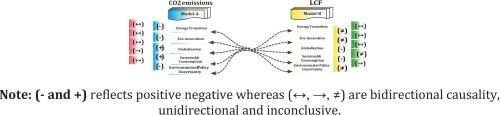
Carbon emissions cause climate change, a danger to society and the environment. Despite efforts, the US remains one of the largest carbon dioxide emitters, which may lead to rising seas, increased natural disasters, and ecological catastrophes. Therefore, we need policies that are immediately effective in preventing carbon emissions. In this perspective, this study scrutinizes the role of Energy Transition (ET), Eco-Innovation (EINO), Globalization (GN), Sustainable Consumption (SC), and Climate Policy Uncertainty (CPU) on CO2 emissions and Load Capacity Factor (LCF) from 1980 to 2019. Utilizing cutting-edge econometric techniques includes dynamic Autoregressive Distributed Lag (ARDL) simulations and Cumulative Fourier Frequency Domain Causality (CFFDC). The results indicate that EINO reduces emissions, while ET and CPU provide short-term reductions. Conversely, GN and SC shortly upsurge emissions, though SC behaves differently under CFFDC analysis. The study also divulges bidirectional causality among most variables, with GN and SC significantly impacting LCF in specific models. These findings underscore the importance of implementing targeted policies, such as carbon taxes, incentives for renewable energy adoption, and stringent emissions regulations, to achieve Sustainable Development Goals (SDGs) 7 and 13. In conclusion, such policy measures are critical for the United States to contribute effectively to global efforts to combat climate change.
期刊介绍:
Gondwana Research (GR) is an International Journal aimed to promote high quality research publications on all topics related to solid Earth, particularly with reference to the origin and evolution of continents, continental assemblies and their resources. GR is an "all earth science" journal with no restrictions on geological time, terrane or theme and covers a wide spectrum of topics in geosciences such as geology, geomorphology, palaeontology, structure, petrology, geochemistry, stable isotopes, geochronology, economic geology, exploration geology, engineering geology, geophysics, and environmental geology among other themes, and provides an appropriate forum to integrate studies from different disciplines and different terrains. In addition to regular articles and thematic issues, the journal invites high profile state-of-the-art reviews on thrust area topics for its column, ''GR FOCUS''. Focus articles include short biographies and photographs of the authors. Short articles (within ten printed pages) for rapid publication reporting important discoveries or innovative models of global interest will be considered under the category ''GR LETTERS''.





 京公网安备 11010802042870号
京ICP备2023020795号-1
 分享
 求助内容:
 应助结果提醒方式:
 扫码关注我们
