Yi-Zhe Ren, Ming-Na Zhao, Feng-Lin Du, Lei Wu, Lin Wang, Jia-Tao Lou
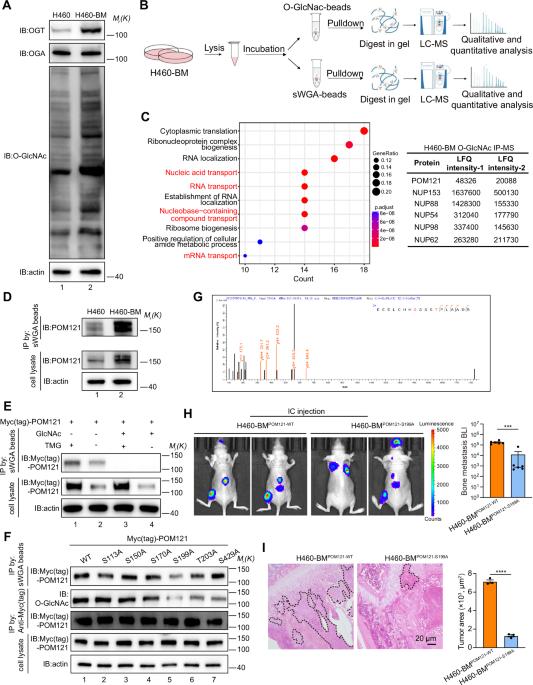
{"title":"POM121 O-GlcNAcylation facilitates bone metastasis in non-small cell lung cancer through enhanced c-MYC nuclear import and ECM reprogramming","authors":"Yi-Zhe Ren, Ming-Na Zhao, Feng-Lin Du, Lei Wu, Lin Wang, Jia-Tao Lou","doi":"10.1038/s41388-026-03687-y","DOIUrl":null,"url":null,"abstract":"Bone metastasis is a devastating complication of non-small cell lung cancer (NSCLC), critically impairing patient survival. Nevertheless, the underlying molecular mechanisms driving this aggressive process remain incompletely elucidated. To systematically investigate these mechanisms, we compared a highly bone-metastatic NSCLC subpopulation with its parental cells. Notably, we identified elevated expression of O-linked β-N-acetylglucosamine transferase (OGT) in the metastatic subpopulation. We further demonstrated that O-GlcNAcylation at the Ser199 site of the nuclear pore protein POM121 is markedly increased and drives NSCLC bone metastasis. Mechanistically, O-GlcNAcylation of POM121 attenuates its interaction with the E3 ubiquitin ligase TRIM21, thus antagonizing ubiquitination and stabilizing POM121. Accumulated POM121 enhances the nuclear import of the oncogenic transcription factor c-MYC. Nuclear c-MYC subsequently orchestrates transcriptional activation of downstream extracellular matrix (ECM)-related genes. Collectively, we elucidate a previously unrecognized OGT-POM121-c-MYC-ECM axis that critically drives NSCLC bone metastasis. Crucially, clinical analysis reveals that high levels of OGT, POM121, and c-MYC positively correlate with adverse clinical outcomes. These findings establish the OGT-POM121-c-MYC-ECM axis as a potential diagnostic biomarker and a promising therapeutic target for NSCLC bone metastasis.","PeriodicalId":19524,"journal":{"name":"Oncogene","volume":"45 7","pages":"728-743"},"PeriodicalIF":7.3000,"publicationDate":"2026-02-02","publicationTypes":"Journal Article","fieldsOfStudy":null,"isOpenAccess":false,"openAccessPdf":"https://www.nature.comhttps://www.nature.com/articles/s41388-026-03687-y.pdf","citationCount":"0","resultStr":null,"platform":"Semanticscholar","paperid":null,"PeriodicalName":"Oncogene","FirstCategoryId":"3","ListUrlMain":"https://www.nature.com/articles/s41388-026-03687-y","RegionNum":1,"RegionCategory":"医学","ArticlePicture":[],"TitleCN":null,"AbstractTextCN":null,"PMCID":null,"EPubDate":"","PubModel":"","JCR":"Q1","JCRName":"BIOCHEMISTRY & MOLECULAR BIOLOGY","Score":null,"Total":0}
引用次数: 0
Abstract
Bone metastasis is a devastating complication of non-small cell lung cancer (NSCLC), critically impairing patient survival. Nevertheless, the underlying molecular mechanisms driving this aggressive process remain incompletely elucidated. To systematically investigate these mechanisms, we compared a highly bone-metastatic NSCLC subpopulation with its parental cells. Notably, we identified elevated expression of O-linked β-N-acetylglucosamine transferase (OGT) in the metastatic subpopulation. We further demonstrated that O-GlcNAcylation at the Ser199 site of the nuclear pore protein POM121 is markedly increased and drives NSCLC bone metastasis. Mechanistically, O-GlcNAcylation of POM121 attenuates its interaction with the E3 ubiquitin ligase TRIM21, thus antagonizing ubiquitination and stabilizing POM121. Accumulated POM121 enhances the nuclear import of the oncogenic transcription factor c-MYC. Nuclear c-MYC subsequently orchestrates transcriptional activation of downstream extracellular matrix (ECM)-related genes. Collectively, we elucidate a previously unrecognized OGT-POM121-c-MYC-ECM axis that critically drives NSCLC bone metastasis. Crucially, clinical analysis reveals that high levels of OGT, POM121, and c-MYC positively correlate with adverse clinical outcomes. These findings establish the OGT-POM121-c-MYC-ECM axis as a potential diagnostic biomarker and a promising therapeutic target for NSCLC bone metastasis.
期刊介绍:
Oncogene is dedicated to advancing our understanding of cancer processes through the publication of exceptional research. The journal seeks to disseminate work that challenges conventional theories and contributes to establishing new paradigms in the etio-pathogenesis, diagnosis, treatment, or prevention of cancers. Emphasis is placed on research shedding light on processes driving metastatic spread and providing crucial insights into cancer biology beyond existing knowledge.
Areas covered include the cellular and molecular biology of cancer, resistance to cancer therapies, and the development of improved approaches to enhance survival. Oncogene spans the spectrum of cancer biology, from fundamental and theoretical work to translational, applied, and clinical research, including early and late Phase clinical trials, particularly those with biologic and translational endpoints.





 京公网安备 11010802042870号
京ICP备2023020795号-1
京公网安备 11010802042870号
京ICP备2023020795号-1
 分享
分享
 求助内容:
求助内容: 应助结果提醒方式:
 扫码关注我们