Nolan W. Groninger , Monique Campos , Eliott Arroyo , Gayatri Narayanan , Heather N. Burney , Xiaochun Li , Drake E. Dillman , Keith G. Avin , S. Jawad Sher , Sharon L. Karp , Sharon M. Moe , Kenneth Lim
{"title":"Determining Physical Function Measures for Estimating VO2Peak in Patients Receiving Hemodialysis","authors":"Nolan W. Groninger , Monique Campos , Eliott Arroyo , Gayatri Narayanan , Heather N. Burney , Xiaochun Li , Drake E. Dillman , Keith G. Avin , S. Jawad Sher , Sharon L. Karp , Sharon M. Moe , Kenneth Lim","doi":"10.1016/j.xkme.2026.101244","DOIUrl":null,"url":null,"abstract":"<div><h3>Rationale & Objective</h3><div>Cardiopulmonary exercise testing is the gold standard for evaluating cardiovascular functional capacity, as assessed by oxygen uptake at peak exercise (VO<sub>2</sub>Peak). Traditional physical function tests have been proposed as predictive of VO<sub>2</sub>Peak, although their associations remain inconclusive in individuals with kidney failure. This study aimed to assess whether comprehensive physical function metrics are associated with VO<sub>2</sub>Peak in patients receiving hemodialysis.</div></div><div><h3>Study Design</h3><div>Cross-sectional analysis from the “Effects of Long Interdialytic Intervals on Cardiovascular Functional Capacity (ECON)” study.</div></div><div><h3>Setting & Participants</h3><div>Thirty patients with kidney failure receiving maintenance thrice-weekly hemodialysis.</div></div><div><h3>Predictors</h3><div>Physical function tests.</div></div><div><h3>Outcomes</h3><div>VO<sub>2</sub>Peak (mL·min<sup>−1</sup>·kg<sup>−1</sup>) measured by cardiopulmonary exercise testing, with participants dichotomized into Low (n=14) and High (n=16) VO<sub>2</sub>Peak groups.</div></div><div><h3>Analytical Approach</h3><div>Group comparisons for demographics and physical function measures were performed. Multivariable linear regression was used to assess associations.</div></div><div><h3>Results</h3><div>The Low and High groups were well matched by age, sex, and race (all <em>P</em> ≥ 0.05). However, body mass index (32.7 ± 6.7 kg/m<sup>2</sup> vs 26.9 ± 6.5 kg/m<sup>2</sup>; <em>P</em> = 0.02) and fat mass composition (41.8 ± 7.3% vs 28.9 ± 12.0%; <em>P</em> = 0.002) were significantly higher in the Low group. The Short Form-36-Physical Function Scale total score, standing static balance test score, number of sit-to-stands in 30 seconds (30sec-STS), total Short Physical Performance Battery score, Patient-Reported Outcomes Measurement Information System physical function computerized adaptive testing, Patient-Reported Outcomes Measurement Information System physical mobility computerized adaptive testing, handgrip strength, and 6-minute walk test were all significantly associated with VO<sub>2</sub>Peak (all <em>P</em> < 0.05). However, after adjusting for age, sex, and fat mass composition, only 30sec-STS was significantly associated with VO<sub>2</sub>Peak (<em>P</em> = 0.04).</div></div><div><h3>Limitations</h3><div>The study’s small sample size and cross-sectional design limit statistical power and causal inference.</div></div><div><h3>Conclusions</h3><div>Metrics of basic physical function demonstrate limited association with VO<sub>2</sub>Peak in patients on hemodialysis, except for the 30sec-STS test.</div></div><div><h3>Plain-Language Summary</h3><div>People with kidney failure often have serious heart and muscle problems that limit their ability to exercise. This study tested how simple physical function tests relate to cardiovascular fitness, measured by oxygen use during exercise (oxygen uptake at peak exercise), in 30 individuals receiving hemodialysis for kidney failure treatment. Participants completed tests such as standing balance, sit-to-stand, walking distance, and handgrip strength. After accounting for age, sex, and body fat, only the 30-second sit-to-stand test remained significantly associated with oxygen uptake at peak exercise. These results suggest that this quick test may provide a useful indication of physical fitness in dialysis patients. Larger studies are needed to confirm these findings and to inform practical assessments of physical health in this population.</div></div>","PeriodicalId":17885,"journal":{"name":"Kidney Medicine","volume":"8 3","pages":"Article 101244"},"PeriodicalIF":3.4000,"publicationDate":"2026-03-01","publicationTypes":"Journal Article","fieldsOfStudy":null,"isOpenAccess":false,"openAccessPdf":"","citationCount":"0","resultStr":null,"platform":"Semanticscholar","paperid":null,"PeriodicalName":"Kidney Medicine","FirstCategoryId":"1085","ListUrlMain":"https://www.sciencedirect.com/science/article/pii/S2590059526000051","RegionNum":0,"RegionCategory":null,"ArticlePicture":[],"TitleCN":null,"AbstractTextCN":null,"PMCID":null,"EPubDate":"2026/1/5 0:00:00","PubModel":"Epub","JCR":"Q1","JCRName":"UROLOGY & NEPHROLOGY","Score":null,"Total":0}
引用次数: 0
Abstract
Rationale & Objective
Cardiopulmonary exercise testing is the gold standard for evaluating cardiovascular functional capacity, as assessed by oxygen uptake at peak exercise (VO2Peak). Traditional physical function tests have been proposed as predictive of VO2Peak, although their associations remain inconclusive in individuals with kidney failure. This study aimed to assess whether comprehensive physical function metrics are associated with VO2Peak in patients receiving hemodialysis.
Study Design
Cross-sectional analysis from the “Effects of Long Interdialytic Intervals on Cardiovascular Functional Capacity (ECON)” study.
Setting & Participants
Thirty patients with kidney failure receiving maintenance thrice-weekly hemodialysis.
Predictors
Physical function tests.
Outcomes
VO2Peak (mL·min−1·kg−1) measured by cardiopulmonary exercise testing, with participants dichotomized into Low (n=14) and High (n=16) VO2Peak groups.
Analytical Approach
Group comparisons for demographics and physical function measures were performed. Multivariable linear regression was used to assess associations.
Results
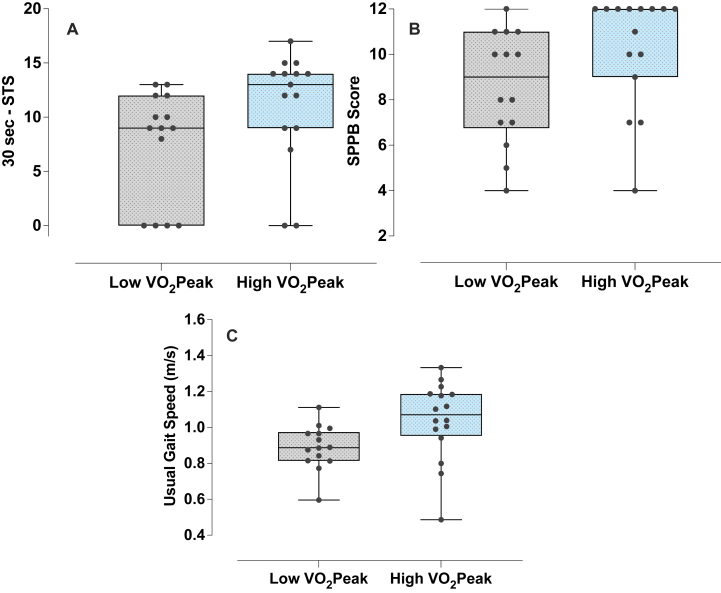
The Low and High groups were well matched by age, sex, and race (all P ≥ 0.05). However, body mass index (32.7 ± 6.7 kg/m2 vs 26.9 ± 6.5 kg/m2; P = 0.02) and fat mass composition (41.8 ± 7.3% vs 28.9 ± 12.0%; P = 0.002) were significantly higher in the Low group. The Short Form-36-Physical Function Scale total score, standing static balance test score, number of sit-to-stands in 30 seconds (30sec-STS), total Short Physical Performance Battery score, Patient-Reported Outcomes Measurement Information System physical function computerized adaptive testing, Patient-Reported Outcomes Measurement Information System physical mobility computerized adaptive testing, handgrip strength, and 6-minute walk test were all significantly associated with VO2Peak (all P < 0.05). However, after adjusting for age, sex, and fat mass composition, only 30sec-STS was significantly associated with VO2Peak (P = 0.04).
Limitations
The study’s small sample size and cross-sectional design limit statistical power and causal inference.
Conclusions
Metrics of basic physical function demonstrate limited association with VO2Peak in patients on hemodialysis, except for the 30sec-STS test.
Plain-Language Summary
People with kidney failure often have serious heart and muscle problems that limit their ability to exercise. This study tested how simple physical function tests relate to cardiovascular fitness, measured by oxygen use during exercise (oxygen uptake at peak exercise), in 30 individuals receiving hemodialysis for kidney failure treatment. Participants completed tests such as standing balance, sit-to-stand, walking distance, and handgrip strength. After accounting for age, sex, and body fat, only the 30-second sit-to-stand test remained significantly associated with oxygen uptake at peak exercise. These results suggest that this quick test may provide a useful indication of physical fitness in dialysis patients. Larger studies are needed to confirm these findings and to inform practical assessments of physical health in this population.






 京公网安备 11010802042870号
京ICP备2023020795号-1
京公网安备 11010802042870号
京ICP备2023020795号-1
 分享
分享
 求助内容:
求助内容: 应助结果提醒方式:
 扫码关注我们