{"title":"A rare case report of hepatoblastoma in a child with ectopic adrenocorticotropic hormone syndrome.","authors":"Shuang Gao, Zebin Xiao, Jing Yang, Jiqun Yi, Xianyue Quan, Hong Li, Linlang Guo, Hongzhi Zhao","doi":"10.21037/tgh-25-42","DOIUrl":null,"url":null,"abstract":"<p><strong>Background: </strong>Ectopic adrenocorticotropic hormone (ACTH) secretion is commonly associated with neuroendocrine tumors such as bronchial carcinoids. However, hepatoblastoma presenting with ectopic ACTH syndrome in children is exceedingly rare.</p><p><strong>Case description: </strong>We report a rare case of hepatoblastoma associated with ectopic ACTH secretion in a 3-year-old girl, emphasizing its clinical presentation, pathological features, diagnostic workup, and treatment strategy. The patient presented with rapid weight gain (3 kg over 3 months) and hypertension. Magnetic resonance imaging (MRI) revealed a large mass in the left hepatic lobe, with no abnormalities in the pituitary or adrenal glands. After multidisciplinary consultation, hepatoblastoma with ectopic ACTH syndrome was diagnosed. A retrospective analysis of the clinical data and a literature review were performed to guide treatment. The patient underwent radical resection of the liver tumor. Postoperatively, symptoms including palpitations, excessive sweating, and blood pressure fluctuations gradually resolved, and serum ACTH levels declined. Histopathological examination confirmed mixed-type hepatoblastoma with ectopic ACTH secretion.</p><p><strong>Conclusions: </strong>Hepatoblastoma with ectopic ACTH syndrome is an exceptionally rare entity in children and may present with a wide range of clinical symptoms, increasing the risk of misdiagnosis or inappropriate treatment. Accurate diagnosis requires a comprehensive assessment incorporating clinical findings, biochemical tests, imaging, and pathology. Surgical resection remains the cornerstone of treatment.</p>","PeriodicalId":94362,"journal":{"name":"Translational gastroenterology and hepatology","volume":"11 ","pages":"36"},"PeriodicalIF":2.5000,"publicationDate":"2026-01-22","publicationTypes":"Journal Article","fieldsOfStudy":null,"isOpenAccess":false,"openAccessPdf":"https://www.ncbi.nlm.nih.gov/pmc/articles/PMC12887339/pdf/","citationCount":"0","resultStr":null,"platform":"Semanticscholar","paperid":null,"PeriodicalName":"Translational gastroenterology and hepatology","FirstCategoryId":"1085","ListUrlMain":"https://doi.org/10.21037/tgh-25-42","RegionNum":0,"RegionCategory":null,"ArticlePicture":[],"TitleCN":null,"AbstractTextCN":null,"PMCID":null,"EPubDate":"2026/1/1 0:00:00","PubModel":"eCollection","JCR":"Q2","JCRName":"GASTROENTEROLOGY & HEPATOLOGY","Score":null,"Total":0}
引用次数: 0
Abstract
Background: Ectopic adrenocorticotropic hormone (ACTH) secretion is commonly associated with neuroendocrine tumors such as bronchial carcinoids. However, hepatoblastoma presenting with ectopic ACTH syndrome in children is exceedingly rare.
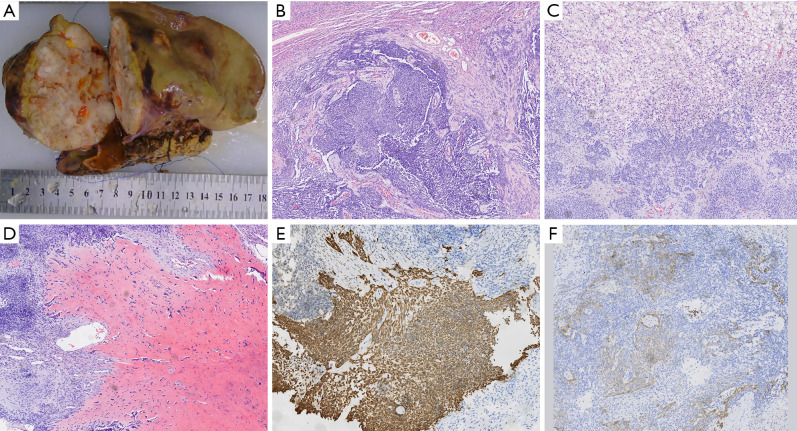
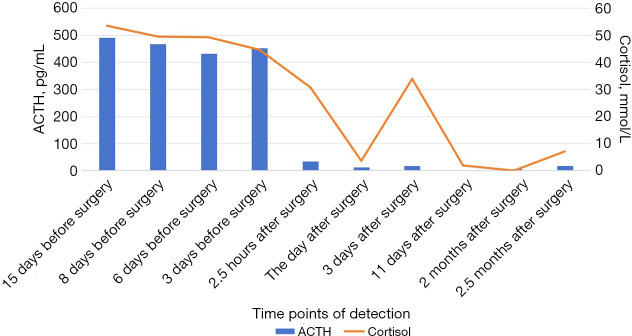
Case description: We report a rare case of hepatoblastoma associated with ectopic ACTH secretion in a 3-year-old girl, emphasizing its clinical presentation, pathological features, diagnostic workup, and treatment strategy. The patient presented with rapid weight gain (3 kg over 3 months) and hypertension. Magnetic resonance imaging (MRI) revealed a large mass in the left hepatic lobe, with no abnormalities in the pituitary or adrenal glands. After multidisciplinary consultation, hepatoblastoma with ectopic ACTH syndrome was diagnosed. A retrospective analysis of the clinical data and a literature review were performed to guide treatment. The patient underwent radical resection of the liver tumor. Postoperatively, symptoms including palpitations, excessive sweating, and blood pressure fluctuations gradually resolved, and serum ACTH levels declined. Histopathological examination confirmed mixed-type hepatoblastoma with ectopic ACTH secretion.
Conclusions: Hepatoblastoma with ectopic ACTH syndrome is an exceptionally rare entity in children and may present with a wide range of clinical symptoms, increasing the risk of misdiagnosis or inappropriate treatment. Accurate diagnosis requires a comprehensive assessment incorporating clinical findings, biochemical tests, imaging, and pathology. Surgical resection remains the cornerstone of treatment.





 京公网安备 11010802042870号
京ICP备2023020795号-1
京公网安备 11010802042870号
京ICP备2023020795号-1
 分享
分享

 求助内容:
求助内容: 应助结果提醒方式:
 扫码关注我们