Effects of natural pyrite and g-C3N4 constructed built-in electric field activated percarbonate on NOR removal: Mechanism, pathways, and toxicity analysis
Shibo Ma , Yuxin Chen , Wenjun Li , Yue Wang , Lihong Hao , Tianwei Qian , Xiaona Liu
{"title":"Effects of natural pyrite and g-C3N4 constructed built-in electric field activated percarbonate on NOR removal: Mechanism, pathways, and toxicity analysis","authors":"Shibo Ma , Yuxin Chen , Wenjun Li , Yue Wang , Lihong Hao , Tianwei Qian , Xiaona Liu","doi":"10.1016/j.jwpe.2026.109592","DOIUrl":null,"url":null,"abstract":"<div><div>The advanced oxidation process (AOP) using sodium percarbonate (SPC) has attracted attention for water purification, but most SPC-based catalysts suffer from metal leaching, limited pH applicability, and low degradation efficiency, limiting their environmental use. In this study, a wet ball-milling technique was used to synthesize a natural pyrite and g-C<sub>3</sub>N<sub>4</sub>-based Fenton-like system with SPC, enabling rapid degradation of norfloxacin (NOR) under neutral conditions. Notably, with low concentrations of catalyst (0.5 g/L) and SPC (0.03 g/L), the degradation reaction rate constant (<em>k</em><sub>obs</sub>) for NOR reached 0.34354 min<sup>−1</sup>, far exceeding traditional Fenton-like reactions. DFT simulations and characterizations such as XPS and TEM indicate that the exceptional reactivity is due to the rectifying contact between pyrite@g-C<sub>3</sub>N<sub>4</sub> and SPC, which generates an internal electric field that enhances electron transfer, halogen bond cleavage, and reaction site exposure. This improves charge mobility, reactivity, and overcomes kinetic limitations of reductive systems. This work demonstrates the potential of natural pyrite in resource utilization and its ability to remove antibiotics from wastewater more efficiently and at a lower cost using iron-based catalysts without chemical synthesis.</div></div>","PeriodicalId":17528,"journal":{"name":"Journal of water process engineering","volume":"83 ","pages":"Article 109592"},"PeriodicalIF":6.6000,"publicationDate":"2026-03-01","publicationTypes":"Journal Article","fieldsOfStudy":null,"isOpenAccess":false,"openAccessPdf":"","citationCount":"0","resultStr":null,"platform":"Semanticscholar","paperid":null,"PeriodicalName":"Journal of water process engineering","FirstCategoryId":"5","ListUrlMain":"https://www.sciencedirect.com/science/article/pii/S2214714426001509","RegionNum":2,"RegionCategory":"工程技术","ArticlePicture":[],"TitleCN":null,"AbstractTextCN":null,"PMCID":null,"EPubDate":"2026/2/3 0:00:00","PubModel":"Epub","JCR":"Q1","JCRName":"ENGINEERING, CHEMICAL","Score":null,"Total":0}
引用次数: 0
Abstract
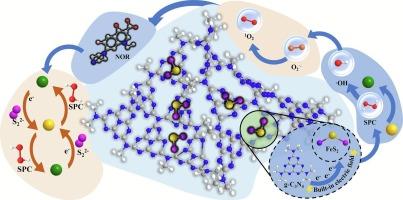
The advanced oxidation process (AOP) using sodium percarbonate (SPC) has attracted attention for water purification, but most SPC-based catalysts suffer from metal leaching, limited pH applicability, and low degradation efficiency, limiting their environmental use. In this study, a wet ball-milling technique was used to synthesize a natural pyrite and g-C3N4-based Fenton-like system with SPC, enabling rapid degradation of norfloxacin (NOR) under neutral conditions. Notably, with low concentrations of catalyst (0.5 g/L) and SPC (0.03 g/L), the degradation reaction rate constant (kobs) for NOR reached 0.34354 min−1, far exceeding traditional Fenton-like reactions. DFT simulations and characterizations such as XPS and TEM indicate that the exceptional reactivity is due to the rectifying contact between pyrite@g-C3N4 and SPC, which generates an internal electric field that enhances electron transfer, halogen bond cleavage, and reaction site exposure. This improves charge mobility, reactivity, and overcomes kinetic limitations of reductive systems. This work demonstrates the potential of natural pyrite in resource utilization and its ability to remove antibiotics from wastewater more efficiently and at a lower cost using iron-based catalysts without chemical synthesis.
期刊介绍:
The Journal of Water Process Engineering aims to publish refereed, high-quality research papers with significant novelty and impact in all areas of the engineering of water and wastewater processing . Papers on advanced and novel treatment processes and technologies are particularly welcome. The Journal considers papers in areas such as nanotechnology and biotechnology applications in water, novel oxidation and separation processes, membrane processes (except those for desalination) , catalytic processes for the removal of water contaminants, sustainable processes, water reuse and recycling, water use and wastewater minimization, integrated/hybrid technology, process modeling of water treatment and novel treatment processes. Submissions on the subject of adsorbents, including standard measurements of adsorption kinetics and equilibrium will only be considered if there is a genuine case for novelty and contribution, for example highly novel, sustainable adsorbents and their use: papers on activated carbon-type materials derived from natural matter, or surfactant-modified clays and related minerals, would not fulfil this criterion. The Journal particularly welcomes contributions involving environmentally, economically and socially sustainable technology for water treatment, including those which are energy-efficient, with minimal or no chemical consumption, and capable of water recycling and reuse that minimizes the direct disposal of wastewater to the aquatic environment. Papers that describe novel ideas for solving issues related to water quality and availability are also welcome, as are those that show the transfer of techniques from other disciplines. The Journal will consider papers dealing with processes for various water matrices including drinking water (except desalination), domestic, urban and industrial wastewaters, in addition to their residues. It is expected that the journal will be of particular relevance to chemical and process engineers working in the field. The Journal welcomes Full Text papers, Short Communications, State-of-the-Art Reviews and Letters to Editors and Case Studies





 京公网安备 11010802042870号
京ICP备2023020795号-1
京公网安备 11010802042870号
京ICP备2023020795号-1
 分享
分享
 求助内容:
求助内容: 应助结果提醒方式:
 扫码关注我们