{"title":"Fibrosis activity vs. disease stage: Complementary and independent predictors of outcomes in alcohol-related liver disease","authors":"Stine Johansen , Mads Israelsen , Katrine Holtz Thorhauge , Johanne Kragh Hansen , Camilla Dalby Hansen , Helle Lindholm Schnefeld , Peter Andersen , Ida Villesen , Katrine Tholstrup Bech , Sönke Detlefsen , Nikolaj Torp , Diana Leeming , Maja Thiele , Aleksander Krag , Morten Karsdal , GALAXY consortia","doi":"10.1016/j.jhepr.2026.101746","DOIUrl":null,"url":null,"abstract":"<div><h3>Background & Aims</h3><div>Excessive alcohol consumption accelerates fibrosis progression in steatotic liver disease. Disease activity can be described by fibrogenic activity, of which collagen formation is a central process. Type III collagen formation (PRO-C3) is a biomarker of fibrosis activity. We aimed to evaluate whether PRO-C3 predicts clinical outcomes in alcohol-related liver disease (ALD) independent of fibrosis stage.</div></div><div><h3>Methods</h3><div>We conducted a prospective cohort study including patients with prior or current excessive alcohol intake (men: ≥36 g/day; women: ≥24 g/day for >1 year) and no prior decompensation. At baseline, liver biopsies, clinical investigations, and non-invasive blood tests were performed. During follow-up, patients’ electronic healthcare records were manually reviewed for decompensation events and all-cause mortality. Decompensation was defined according to Baveno VII recommendations.</div></div><div><h3>Results</h3><div>We followed 458 patients with ALD (76% male; mean age 57 ± 10 years) for a median of 5.9 years (IQR 4.5–7.8). At baseline, fibrosis stages were F0–1 (n = 260), F2 (n = 107), and F3-4 (n = 91). During follow-up, 67 patients experienced decompensation and 100 died. PRO-C3 provided prognostic value beyond fibrosis stage as a predictor of decompensation, both in patients with no to moderate fibrosis (F0-2; subhazard ratio per unit increase in PRO-C3 1.05; 95% CI 1.03–1.07; <em>p</em> <0.001) and in patients with cirrhosis (F4; subhazard ratio 1.01; 95% CI 1.00–1.03; <em>p</em> = 0.048).</div></div><div><h3>Conclusions</h3><div>In ALD, prognosis is determined by both baseline fibrosis stage and markers of fibrosis activity. PRO-C3, a biomarker of fibrosis activity, was more strongly associated with the risk of decompensation than Kleiner fibrosis stage and predicted decompensation across fibrosis stages.</div></div><div><h3>Impact and implications</h3><div>This study shows that fibrosis activity measured by PRO-C3 captures dynamic disease processes in alcohol-related liver disease that are not fully reflected by histological fibrosis stage. These findings are important for clinicians and patients because PRO-C3 independently predicts decompensation and supports stratifying risk by fibrosis activity in addition to stage. Practically, incorporating fibrosis-activity biomarkers could guide earlier monitoring and interventions aimed at modulating fibrogenic activity.</div></div>","PeriodicalId":14764,"journal":{"name":"JHEP Reports","volume":"8 3","pages":"Article 101746"},"PeriodicalIF":7.5000,"publicationDate":"2026-03-01","publicationTypes":"Journal Article","fieldsOfStudy":null,"isOpenAccess":false,"openAccessPdf":"","citationCount":"0","resultStr":null,"platform":"Semanticscholar","paperid":null,"PeriodicalName":"JHEP Reports","FirstCategoryId":"3","ListUrlMain":"https://www.sciencedirect.com/science/article/pii/S2589555926000169","RegionNum":1,"RegionCategory":"医学","ArticlePicture":[],"TitleCN":null,"AbstractTextCN":null,"PMCID":null,"EPubDate":"2026/1/22 0:00:00","PubModel":"Epub","JCR":"Q1","JCRName":"GASTROENTEROLOGY & HEPATOLOGY","Score":null,"Total":0}
引用次数: 0
Abstract
Background & Aims
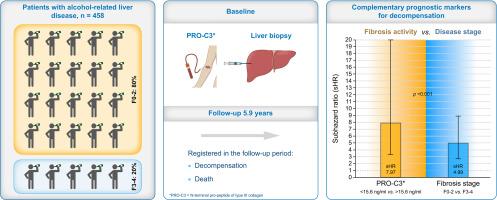
Excessive alcohol consumption accelerates fibrosis progression in steatotic liver disease. Disease activity can be described by fibrogenic activity, of which collagen formation is a central process. Type III collagen formation (PRO-C3) is a biomarker of fibrosis activity. We aimed to evaluate whether PRO-C3 predicts clinical outcomes in alcohol-related liver disease (ALD) independent of fibrosis stage.
Methods
We conducted a prospective cohort study including patients with prior or current excessive alcohol intake (men: ≥36 g/day; women: ≥24 g/day for >1 year) and no prior decompensation. At baseline, liver biopsies, clinical investigations, and non-invasive blood tests were performed. During follow-up, patients’ electronic healthcare records were manually reviewed for decompensation events and all-cause mortality. Decompensation was defined according to Baveno VII recommendations.
Results
We followed 458 patients with ALD (76% male; mean age 57 ± 10 years) for a median of 5.9 years (IQR 4.5–7.8). At baseline, fibrosis stages were F0–1 (n = 260), F2 (n = 107), and F3-4 (n = 91). During follow-up, 67 patients experienced decompensation and 100 died. PRO-C3 provided prognostic value beyond fibrosis stage as a predictor of decompensation, both in patients with no to moderate fibrosis (F0-2; subhazard ratio per unit increase in PRO-C3 1.05; 95% CI 1.03–1.07; p <0.001) and in patients with cirrhosis (F4; subhazard ratio 1.01; 95% CI 1.00–1.03; p = 0.048).
Conclusions
In ALD, prognosis is determined by both baseline fibrosis stage and markers of fibrosis activity. PRO-C3, a biomarker of fibrosis activity, was more strongly associated with the risk of decompensation than Kleiner fibrosis stage and predicted decompensation across fibrosis stages.
Impact and implications
This study shows that fibrosis activity measured by PRO-C3 captures dynamic disease processes in alcohol-related liver disease that are not fully reflected by histological fibrosis stage. These findings are important for clinicians and patients because PRO-C3 independently predicts decompensation and supports stratifying risk by fibrosis activity in addition to stage. Practically, incorporating fibrosis-activity biomarkers could guide earlier monitoring and interventions aimed at modulating fibrogenic activity.
期刊介绍:
JHEP Reports is an open access journal that is affiliated with the European Association for the Study of the Liver (EASL). It serves as a companion journal to the highly respected Journal of Hepatology.
The primary objective of JHEP Reports is to publish original papers and reviews that contribute to the advancement of knowledge in the field of liver diseases. The journal covers a wide range of topics, including basic, translational, and clinical research. It also focuses on global issues in hepatology, with particular emphasis on areas such as clinical trials, novel diagnostics, precision medicine and therapeutics, cancer research, cellular and molecular studies, artificial intelligence, microbiome research, epidemiology, and cutting-edge technologies.
In summary, JHEP Reports is dedicated to promoting scientific discoveries and innovations in liver diseases through the publication of high-quality research papers and reviews covering various aspects of hepatology.





 京公网安备 11010802042870号
京ICP备2023020795号-1
京公网安备 11010802042870号
京ICP备2023020795号-1
 分享
分享
 求助内容:
求助内容: 应助结果提醒方式:
 扫码关注我们