A quantitative decision-support framework for assessing the feasibility and sensitivity of wastewater-based epidemiology of respiratory virus surveillance
{"title":"A quantitative decision-support framework for assessing the feasibility and sensitivity of wastewater-based epidemiology of respiratory virus surveillance","authors":"Sunita Samantarat , Kwanrawee Sirikanchana , Yong Poovorawan , Jatuwat Sangsanont","doi":"10.1016/j.ijheh.2026.114765","DOIUrl":null,"url":null,"abstract":"<div><div>Wastewater-based epidemiology (WBE) has emerged as a cost-effective and non-invasive tool for monitoring infectious diseases. However, its practical implementation for virus surveillance remains challenged by uncertainty in detection sensitivity, which depends on both pathogen-specific and methodological factors. This study applies a quantitative decision-support framework to prospectively evaluate the feasibility and sensitivity of WBE, with a specific focus on estimating the minimum number of infected individuals required for reliable detection, for SARS-CoV-2, respiratory syncytial virus (RSV), influenza A virus (IAV), and rhinovirus (RhV), using year-round weekly wastewater data. SARS-CoV-2 was detected throughout the year, and RSV exhibited seasonal detection, whereas IAV and RhV were undetected despite concurrent clinical circulation. To interpret these observations, a Monte Carlo simulation framework incorporating fecal shedding rates, recovery efficiency, and RNA decay was used to assess detection feasibility prior to large-scale deployment. The model indicated that SARS-CoV-2 required the lowest infections to surpass a 50% detection threshold (0.85 per 100,000 population), followed by RSV and RhV, while IAV had the highest threshold (1177.02 per 100,000), primarily due to low fecal shedding. Sensitivity analysis identified viral shedding and recovery efficiency as the most influential parameters. Simulations further suggested that droplet digital PCR combined with recovery efficiencies ≥35% could enable reliable detection of all four viruses under urban conditions. Overall, these findings demonstrate that WBE sensitivity is jointly governed by virus-specific characteristics and methodological performance. The proposed framework, informed by field observations, provides a transparent and data-driven approach for feasibility-oriented planning and methodological optimization of WBE surveillance programs.</div></div>","PeriodicalId":13994,"journal":{"name":"International journal of hygiene and environmental health","volume":"273 ","pages":"Article 114765"},"PeriodicalIF":4.4000,"publicationDate":"2026-04-01","publicationTypes":"Journal Article","fieldsOfStudy":null,"isOpenAccess":false,"openAccessPdf":"","citationCount":"0","resultStr":null,"platform":"Semanticscholar","paperid":null,"PeriodicalName":"International journal of hygiene and environmental health","FirstCategoryId":"3","ListUrlMain":"https://www.sciencedirect.com/science/article/pii/S1438463926000258","RegionNum":2,"RegionCategory":"医学","ArticlePicture":[],"TitleCN":null,"AbstractTextCN":null,"PMCID":null,"EPubDate":"2026/2/23 0:00:00","PubModel":"Epub","JCR":"Q1","JCRName":"INFECTIOUS DISEASES","Score":null,"Total":0}
引用次数: 0
Abstract
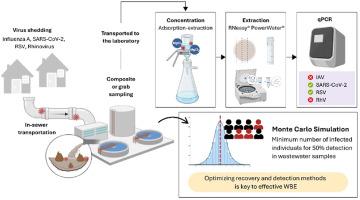
Wastewater-based epidemiology (WBE) has emerged as a cost-effective and non-invasive tool for monitoring infectious diseases. However, its practical implementation for virus surveillance remains challenged by uncertainty in detection sensitivity, which depends on both pathogen-specific and methodological factors. This study applies a quantitative decision-support framework to prospectively evaluate the feasibility and sensitivity of WBE, with a specific focus on estimating the minimum number of infected individuals required for reliable detection, for SARS-CoV-2, respiratory syncytial virus (RSV), influenza A virus (IAV), and rhinovirus (RhV), using year-round weekly wastewater data. SARS-CoV-2 was detected throughout the year, and RSV exhibited seasonal detection, whereas IAV and RhV were undetected despite concurrent clinical circulation. To interpret these observations, a Monte Carlo simulation framework incorporating fecal shedding rates, recovery efficiency, and RNA decay was used to assess detection feasibility prior to large-scale deployment. The model indicated that SARS-CoV-2 required the lowest infections to surpass a 50% detection threshold (0.85 per 100,000 population), followed by RSV and RhV, while IAV had the highest threshold (1177.02 per 100,000), primarily due to low fecal shedding. Sensitivity analysis identified viral shedding and recovery efficiency as the most influential parameters. Simulations further suggested that droplet digital PCR combined with recovery efficiencies ≥35% could enable reliable detection of all four viruses under urban conditions. Overall, these findings demonstrate that WBE sensitivity is jointly governed by virus-specific characteristics and methodological performance. The proposed framework, informed by field observations, provides a transparent and data-driven approach for feasibility-oriented planning and methodological optimization of WBE surveillance programs.
期刊介绍:
The International Journal of Hygiene and Environmental Health serves as a multidisciplinary forum for original reports on exposure assessment and the reactions to and consequences of human exposure to the biological, chemical, and physical environment. Research reports, short communications, reviews, scientific comments, technical notes, and editorials will be peer-reviewed before acceptance for publication. Priority will be given to articles on epidemiological aspects of environmental toxicology, health risk assessments, susceptible (sub) populations, sanitation and clean water, human biomonitoring, environmental medicine, and public health aspects of exposure-related outcomes.




 京公网安备 11010802042870号
京ICP备2023020795号-1
京公网安备 11010802042870号
京ICP备2023020795号-1
 分享
分享

 求助内容:
求助内容: 应助结果提醒方式:
 扫码关注我们