{"title":"Factors associated with longitudinal MDS-UPDRS III score trajectories in early-stage Parkinson's disease.","authors":"Wen Zhou, Duan Liu, Tian-Fang Zeng, Qing-Qing Xia","doi":"10.3389/fnins.2026.1759090","DOIUrl":null,"url":null,"abstract":"<p><strong>Background: </strong>Parkinson's disease (PD) exhibits significant clinical heterogeneity, particularly in motor symptom progression. This study aims to identify distinct trajectories of motor progression in PD and explore associated predictive factors.</p><p><strong>Methods: </strong>Data were obtained from the Parkinson's Progression Markers Initiative (PPMI) database on [2025-3-25]. Motor symptom severity was measured using the MDS-UPDRS III scores. Latent class trajectory analysis was used to identify distinct progression patterns. Multinomial logistic regression and machine learning models were used to evaluate predictors.</p><p><strong>Results: </strong>Three distinct motor progression trajectories were identified: slow progression (38%), moderate progression (55.9%), and rapid progression (6.1%). Compared to the slow progression group, a higher baseline MDS-UPDRS III score was strongly associated with both moderate (OR = 1.27, 95% CI: 1.23-1.31, <i>p</i> < 0.001) and rapid progression (OR = 1.49, 95% CI: 1.43-1.57, <i>p</i> < 0.001). Lower serum albumin levels also significantly increased the likelihood of moderate (OR = 0.95, 95% CI: 0.91-0.99, <i>p</i> = 0.014) and rapid progression (OR = 0.89, 95% CI: 0.81-0.98, <i>p</i> = 0.016). Additionally, higher baseline BMI (per 5 kg/m<sup>2</sup> increase) was associated with greater odds of moderate (OR = 1.19, 95% CI: 1.01-1.41, <i>p</i> = 0.042). Finally, each 1-unit lower mean striatum specific binding ratio (SBR) reduced the odds of moderate progression by 32% compared with the slow-progression group (OR = 0.68, 95% CI: 0.46-0.99, <i>p</i> = 0.044). Machine learning analysis confirmed the predictive importance of these factors, with the Random Forest model achieving an AUC of 0.950.</p><p><strong>Conclusion: </strong>Baseline motor severity, dopaminergic imaging, nutritional status, and body weight are key predictors of motor progression in PD. These findings highlight the potential for early risk stratification and personalized management strategies.</p>","PeriodicalId":12639,"journal":{"name":"Frontiers in Neuroscience","volume":"20 ","pages":"1759090"},"PeriodicalIF":3.2000,"publicationDate":"2026-02-20","publicationTypes":"Journal Article","fieldsOfStudy":null,"isOpenAccess":false,"openAccessPdf":"https://www.ncbi.nlm.nih.gov/pmc/articles/PMC12963062/pdf/","citationCount":"0","resultStr":null,"platform":"Semanticscholar","paperid":null,"PeriodicalName":"Frontiers in Neuroscience","FirstCategoryId":"3","ListUrlMain":"https://doi.org/10.3389/fnins.2026.1759090","RegionNum":3,"RegionCategory":"医学","ArticlePicture":[],"TitleCN":null,"AbstractTextCN":null,"PMCID":null,"EPubDate":"2026/1/1 0:00:00","PubModel":"eCollection","JCR":"Q2","JCRName":"NEUROSCIENCES","Score":null,"Total":0}
引用次数: 0
Abstract
Background: Parkinson's disease (PD) exhibits significant clinical heterogeneity, particularly in motor symptom progression. This study aims to identify distinct trajectories of motor progression in PD and explore associated predictive factors.
Methods: Data were obtained from the Parkinson's Progression Markers Initiative (PPMI) database on [2025-3-25]. Motor symptom severity was measured using the MDS-UPDRS III scores. Latent class trajectory analysis was used to identify distinct progression patterns. Multinomial logistic regression and machine learning models were used to evaluate predictors.
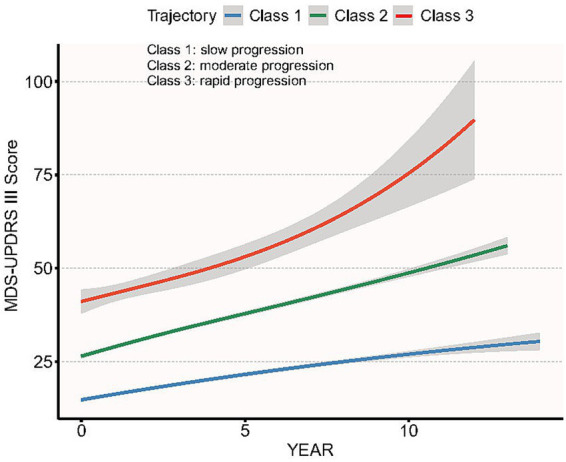
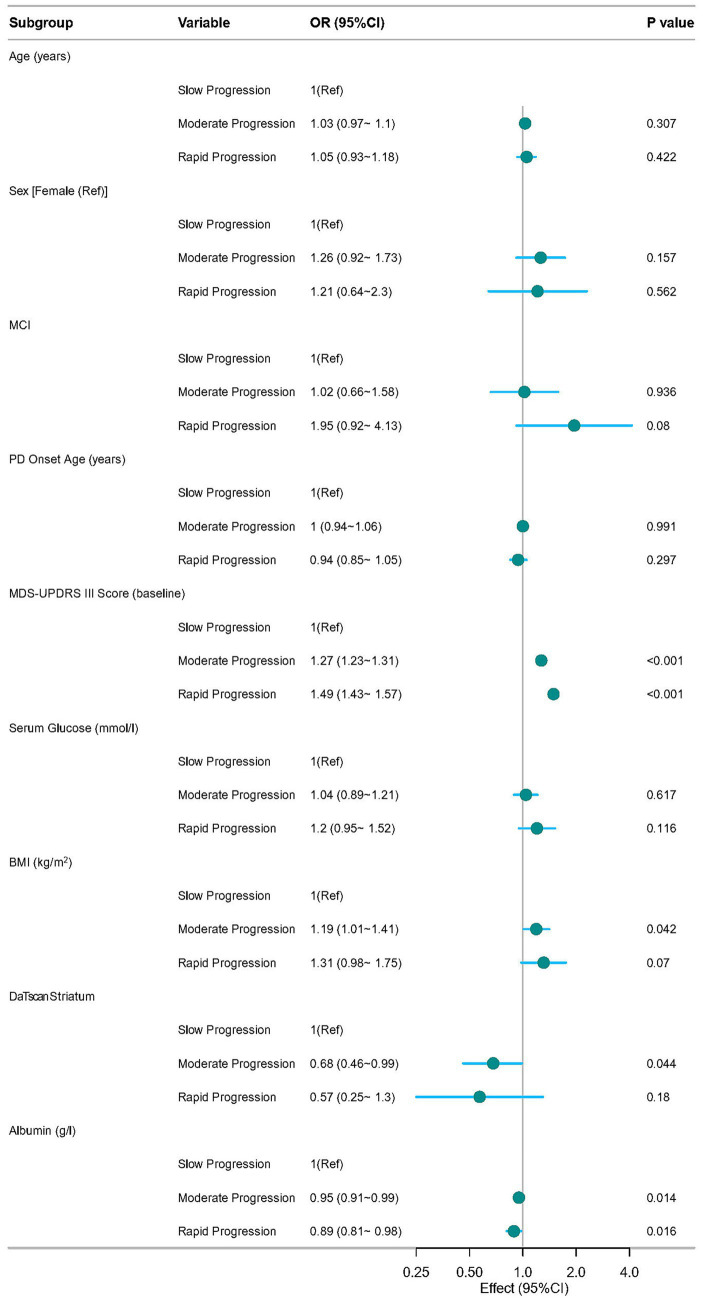
Results: Three distinct motor progression trajectories were identified: slow progression (38%), moderate progression (55.9%), and rapid progression (6.1%). Compared to the slow progression group, a higher baseline MDS-UPDRS III score was strongly associated with both moderate (OR = 1.27, 95% CI: 1.23-1.31, p < 0.001) and rapid progression (OR = 1.49, 95% CI: 1.43-1.57, p < 0.001). Lower serum albumin levels also significantly increased the likelihood of moderate (OR = 0.95, 95% CI: 0.91-0.99, p = 0.014) and rapid progression (OR = 0.89, 95% CI: 0.81-0.98, p = 0.016). Additionally, higher baseline BMI (per 5 kg/m2 increase) was associated with greater odds of moderate (OR = 1.19, 95% CI: 1.01-1.41, p = 0.042). Finally, each 1-unit lower mean striatum specific binding ratio (SBR) reduced the odds of moderate progression by 32% compared with the slow-progression group (OR = 0.68, 95% CI: 0.46-0.99, p = 0.044). Machine learning analysis confirmed the predictive importance of these factors, with the Random Forest model achieving an AUC of 0.950.
Conclusion: Baseline motor severity, dopaminergic imaging, nutritional status, and body weight are key predictors of motor progression in PD. These findings highlight the potential for early risk stratification and personalized management strategies.
期刊介绍:
Neural Technology is devoted to the convergence between neurobiology and quantum-, nano- and micro-sciences. In our vision, this interdisciplinary approach should go beyond the technological development of sophisticated methods and should contribute in generating a genuine change in our discipline.





 京公网安备 11010802042870号
京ICP备2023020795号-1
京公网安备 11010802042870号
京ICP备2023020795号-1
 分享
分享
 求助内容:
求助内容: 应助结果提醒方式:
 扫码关注我们