Poly(ℇ-caprolactone)/gelatin nanofibers loaded with orange peel essential oils for wound healing: Upcycling of a food waste into a wound dressing material
{"title":"Poly(ℇ-caprolactone)/gelatin nanofibers loaded with orange peel essential oils for wound healing: Upcycling of a food waste into a wound dressing material","authors":"Dilara Nur Dikmetas , Aysen Akturk , Dilara Devecioglu , Zeynep Güneş-Özünal , Derya Kahveci , Funda Karbancioglu-Guler , Melek Erol-Taygun","doi":"10.1016/j.bcab.2026.103990","DOIUrl":null,"url":null,"abstract":"<div><div>Utilization of the industrial waste streams into value-added products has become important for sustainability. In this study, essential oil extracted from industrial orange waste was used to develop antibacterial wound dressings demonstrating sufficient cytocompatibility towards keratinocytes and promoting wound healing. For this purpose, orange peel essential oil (OEO), a potent natural antibacterial agent, was used. Morphological, chemical and thermal properties of nanofibers were analyzed. FTIR analysis revealed the presence of PCL and gelatin in the structure. The thermal analysis illustrated that adding a certain amount of OEO led to improved thermal stability. Mechanical properties of obtained samples met the criteria for wound dressing materials. The surface hydrophilicity of the nanofibers was assessed by water contact angle measurements. The developed scaffolds exhibited beneficial characteristics, including release of OEO and appropriate rates of swelling and breakdown, and comparable water vapor transmission rate with commercial wound dressing materials. Nanofiber with 50% of OEO showed antioxidant and antibacterial activity against Gram-positive and Gram-negative bacteria. Furthermore, there were no notable changes to cell viability induced by the obtained samples. The characterization studies, including mechanical tests, swelling capacity, water vapor, antimicrobial and antioxidant activities with cytocompatibility, present that these materials have potential as candidates for wound dressing applications.</div></div>","PeriodicalId":8774,"journal":{"name":"Biocatalysis and agricultural biotechnology","volume":"73 ","pages":"Article 103990"},"PeriodicalIF":3.8000,"publicationDate":"2026-04-01","publicationTypes":"Journal Article","fieldsOfStudy":null,"isOpenAccess":false,"openAccessPdf":"","citationCount":"0","resultStr":null,"platform":"Semanticscholar","paperid":null,"PeriodicalName":"Biocatalysis and agricultural biotechnology","FirstCategoryId":"1085","ListUrlMain":"https://www.sciencedirect.com/science/article/pii/S1878818126000733","RegionNum":0,"RegionCategory":null,"ArticlePicture":[],"TitleCN":null,"AbstractTextCN":null,"PMCID":null,"EPubDate":"2026/2/28 0:00:00","PubModel":"Epub","JCR":"Q2","JCRName":"BIOTECHNOLOGY & APPLIED MICROBIOLOGY","Score":null,"Total":0}
引用次数: 0
Abstract
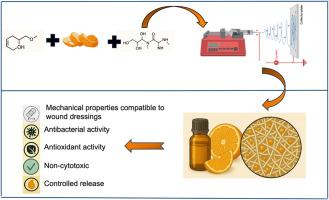
Utilization of the industrial waste streams into value-added products has become important for sustainability. In this study, essential oil extracted from industrial orange waste was used to develop antibacterial wound dressings demonstrating sufficient cytocompatibility towards keratinocytes and promoting wound healing. For this purpose, orange peel essential oil (OEO), a potent natural antibacterial agent, was used. Morphological, chemical and thermal properties of nanofibers were analyzed. FTIR analysis revealed the presence of PCL and gelatin in the structure. The thermal analysis illustrated that adding a certain amount of OEO led to improved thermal stability. Mechanical properties of obtained samples met the criteria for wound dressing materials. The surface hydrophilicity of the nanofibers was assessed by water contact angle measurements. The developed scaffolds exhibited beneficial characteristics, including release of OEO and appropriate rates of swelling and breakdown, and comparable water vapor transmission rate with commercial wound dressing materials. Nanofiber with 50% of OEO showed antioxidant and antibacterial activity against Gram-positive and Gram-negative bacteria. Furthermore, there were no notable changes to cell viability induced by the obtained samples. The characterization studies, including mechanical tests, swelling capacity, water vapor, antimicrobial and antioxidant activities with cytocompatibility, present that these materials have potential as candidates for wound dressing applications.
期刊介绍:
Biocatalysis and Agricultural Biotechnology is the official journal of the International Society of Biocatalysis and Agricultural Biotechnology (ISBAB). The journal publishes high quality articles especially in the science and technology of biocatalysis, bioprocesses, agricultural biotechnology, biomedical biotechnology, and, if appropriate, from other related areas of biotechnology. The journal will publish peer-reviewed basic and applied research papers, authoritative reviews, and feature articles. The scope of the journal encompasses the research, industrial, and commercial aspects of biotechnology, including the areas of: biocatalysis; bioprocesses; food and agriculture; genetic engineering; molecular biology; healthcare and pharmaceuticals; biofuels; genomics; nanotechnology; environment and biodiversity; and bioremediation.





 京公网安备 11010802042870号
京ICP备2023020795号-1
京公网安备 11010802042870号
京ICP备2023020795号-1
 分享
分享
 求助内容:
求助内容: 应助结果提醒方式:
 扫码关注我们