{"title":"Ethanol conversion using copper or iron impregnated titanium-pillared bentonite catalysts","authors":"Funda Turgut Basoglu , Fatma Tomul","doi":"10.1016/j.jics.2026.102535","DOIUrl":null,"url":null,"abstract":"<div><div>Ti-pillared bentonite (Ti-PB) was synthesized starting from raw bentonite, which was obtained from the Hançılı area in the Middle Anatolia region. This material was subsequently impregnated with either iron or copper from solution. XRD analysis confirmed that the TiO<sub>2</sub> anatase phase was present in all synthesized samples. The Ti-PB support exhibited a specific BET surface area of 346 m<sup>2</sup>g<sup>-1</sup> and a micropore volume of 0.092 cm<sup>3</sup>g<sup>-1</sup>, with a corresponding basal spacing of 4.40 nm at 500 °C. The introduction of iron or copper led to only minor variations in these surface areas. XPS analysis identified Cu 2p<sub>3/2</sub> and 2p<sub>1</sub> peaks corresponding to CuO (Cu<sup>2+</sup>), as well as Fe 2p<sub>3</sub> and 2p<sub>1</sub> peaks attributed to Fe<sub>3</sub>O<sub>4</sub> (Fe<sup>2+</sup>/Fe<sup>3+</sup>) in the copper or iron incorporated Ti-PB catalysts. The mass loss for the metal-containing Ti-PBs was 13% lower than that of the support up to 700 °C. The Ti-PB material was found to possess both Lewis and Brønsted acid sites, the incorporation of copper significantly enhanced the Lewis acidity. These acidic centers acted as active sites, significantly impacting the reaction pathways for ethanol conversion and the formation of ethylene. Homogeneous distribution of copper or iron oxide structures across the surfaces of both the natural bentonite layers and the titanium pillars was observed. At 400 °C, Cu@Ti-PB reached 80% ethanol conversion with 75% ethylene selectivity, 60% ethylene yield and 7% acetaldehyde selectivity, 6% acetaldehyde yield, while Fe@Ti-PB achieved 65% conversion with 40% ethylene selectivity, 26% ethylene yield and 31% acetaldehyde selectivity, 20% acetaldehyde yield.</div></div>","PeriodicalId":17276,"journal":{"name":"Journal of the Indian Chemical Society","volume":"103 5","pages":"Article 102535"},"PeriodicalIF":3.4000,"publicationDate":"2026-05-01","publicationTypes":"Journal Article","fieldsOfStudy":null,"isOpenAccess":false,"openAccessPdf":"","citationCount":"0","resultStr":null,"platform":"Semanticscholar","paperid":null,"PeriodicalName":"Journal of the Indian Chemical Society","FirstCategoryId":"92","ListUrlMain":"https://www.sciencedirect.com/science/article/pii/S001945222600138X","RegionNum":4,"RegionCategory":"化学","ArticlePicture":[],"TitleCN":null,"AbstractTextCN":null,"PMCID":null,"EPubDate":"2026/3/10 0:00:00","PubModel":"Epub","JCR":"Q2","JCRName":"CHEMISTRY, MULTIDISCIPLINARY","Score":null,"Total":0}
引用次数: 0
Abstract
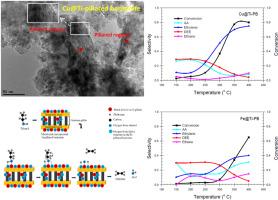
Ti-pillared bentonite (Ti-PB) was synthesized starting from raw bentonite, which was obtained from the Hançılı area in the Middle Anatolia region. This material was subsequently impregnated with either iron or copper from solution. XRD analysis confirmed that the TiO2 anatase phase was present in all synthesized samples. The Ti-PB support exhibited a specific BET surface area of 346 m2g-1 and a micropore volume of 0.092 cm3g-1, with a corresponding basal spacing of 4.40 nm at 500 °C. The introduction of iron or copper led to only minor variations in these surface areas. XPS analysis identified Cu 2p3/2 and 2p1 peaks corresponding to CuO (Cu2+), as well as Fe 2p3 and 2p1 peaks attributed to Fe3O4 (Fe2+/Fe3+) in the copper or iron incorporated Ti-PB catalysts. The mass loss for the metal-containing Ti-PBs was 13% lower than that of the support up to 700 °C. The Ti-PB material was found to possess both Lewis and Brønsted acid sites, the incorporation of copper significantly enhanced the Lewis acidity. These acidic centers acted as active sites, significantly impacting the reaction pathways for ethanol conversion and the formation of ethylene. Homogeneous distribution of copper or iron oxide structures across the surfaces of both the natural bentonite layers and the titanium pillars was observed. At 400 °C, Cu@Ti-PB reached 80% ethanol conversion with 75% ethylene selectivity, 60% ethylene yield and 7% acetaldehyde selectivity, 6% acetaldehyde yield, while Fe@Ti-PB achieved 65% conversion with 40% ethylene selectivity, 26% ethylene yield and 31% acetaldehyde selectivity, 20% acetaldehyde yield.
期刊介绍:
The Journal of the Indian Chemical Society publishes original, fundamental, theorical, experimental research work of highest quality in all areas of chemistry, biochemistry, medicinal chemistry, electrochemistry, agrochemistry, chemical engineering and technology, food chemistry, environmental chemistry, etc.




 京公网安备 11010802042870号
京ICP备2023020795号-1
京公网安备 11010802042870号
京ICP备2023020795号-1
 分享
分享

 求助内容:
求助内容: 应助结果提醒方式:
 扫码关注我们