{"title":"Effect of Video-Assisted Reflective Practice on Infection Control Performance During Oral Hygiene Procedures Performed by Dental Hygienists.","authors":"Myoung-Hee Kim, Young Sun Hwang","doi":"10.3290/j.ohpd.c_2491","DOIUrl":null,"url":null,"abstract":"<p><strong>Purpose: </strong>The dental clinic environment is highly vulnerable to cross-infection from patients' blood and oral fluids. Regular training is vital to prevent cross-contamination between healthcare providers and patients. This study evaluated the effectiveness of video-assisted reflective practice compared to traditional verbal Instruction for infection-control education.</p><p><strong>Materials and methods: </strong>Dental hygienists participated in the study, during which their dental calculus removal procedures were video-recorded. Participants were randomly assigned to one of two groups: the verbal instruction group received conventional training on infection control, while the video-assisted reflective practice group reviewed video recordings of their own clinical performance with guidance from a researcher. Following the educational intervention, all participants repeated the calculus removal procedure, and this session was also recorded. The effectiveness of each instructional method was assessed by analyzing the number of non-clinical surface contacts during dental hygiene procedures in the video recordings, both before and after the intervention.</p><p><strong>Results: </strong>Video analysis revealed that both verbal instruction and video-assisted reflective practice effectively reduced non-clinical surface contact during dental hygiene procedures. However, the reduction was statistically significantly greater in the video-assisted reflective practice group. Notably, the dental unit chair and the clinician's knee, identified as the most frequent contact sites, showed statistically significantly greater reductions in contact frequency in this group compared to the verbal instruction group.</p><p><strong>Conclusion: </strong>This study demonstrates that video-assisted reflective practice, which allows clinicians to reflect on their own behavior, is effective for infection control training. When combined with verbal instruction, it may further enhance dental hygienists' self-directed competence.</p>","PeriodicalId":19696,"journal":{"name":"Oral health & preventive dentistry","volume":"24 ","pages":"219-225"},"PeriodicalIF":1.4000,"publicationDate":"2026-03-17","publicationTypes":"Journal Article","fieldsOfStudy":null,"isOpenAccess":false,"openAccessPdf":"https://www.ncbi.nlm.nih.gov/pmc/articles/PMC12994231/pdf/","citationCount":"0","resultStr":null,"platform":"Semanticscholar","paperid":null,"PeriodicalName":"Oral health & preventive dentistry","FirstCategoryId":"3","ListUrlMain":"https://doi.org/10.3290/j.ohpd.c_2491","RegionNum":4,"RegionCategory":"医学","ArticlePicture":[],"TitleCN":null,"AbstractTextCN":null,"PMCID":null,"EPubDate":"","PubModel":"","JCR":"Q3","JCRName":"DENTISTRY, ORAL SURGERY & MEDICINE","Score":null,"Total":0}
引用次数: 0
Abstract
Purpose: The dental clinic environment is highly vulnerable to cross-infection from patients' blood and oral fluids. Regular training is vital to prevent cross-contamination between healthcare providers and patients. This study evaluated the effectiveness of video-assisted reflective practice compared to traditional verbal Instruction for infection-control education.
Materials and methods: Dental hygienists participated in the study, during which their dental calculus removal procedures were video-recorded. Participants were randomly assigned to one of two groups: the verbal instruction group received conventional training on infection control, while the video-assisted reflective practice group reviewed video recordings of their own clinical performance with guidance from a researcher. Following the educational intervention, all participants repeated the calculus removal procedure, and this session was also recorded. The effectiveness of each instructional method was assessed by analyzing the number of non-clinical surface contacts during dental hygiene procedures in the video recordings, both before and after the intervention.
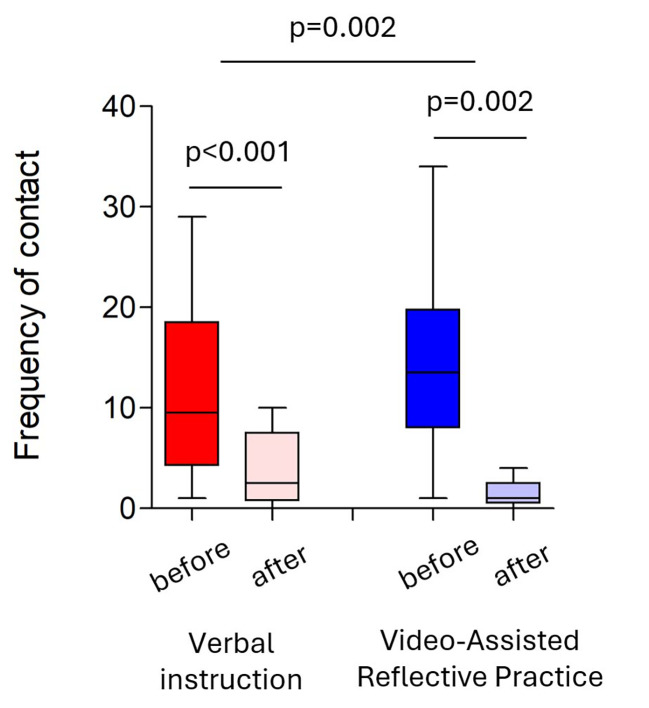
Results: Video analysis revealed that both verbal instruction and video-assisted reflective practice effectively reduced non-clinical surface contact during dental hygiene procedures. However, the reduction was statistically significantly greater in the video-assisted reflective practice group. Notably, the dental unit chair and the clinician's knee, identified as the most frequent contact sites, showed statistically significantly greater reductions in contact frequency in this group compared to the verbal instruction group.
Conclusion: This study demonstrates that video-assisted reflective practice, which allows clinicians to reflect on their own behavior, is effective for infection control training. When combined with verbal instruction, it may further enhance dental hygienists' self-directed competence.
期刊介绍:
Clinicians, general practitioners, teachers, researchers, and public health administrators will find this journal an indispensable source of essential, timely information about scientific progress in the fields of oral health and the prevention of caries, periodontal diseases, oral mucosal diseases, and dental trauma. Central topics, including oral hygiene, oral epidemiology, oral health promotion, and public health issues, are covered in peer-reviewed articles such as clinical and basic science research reports; reviews; invited focus articles, commentaries, and guest editorials; and symposium, workshop, and conference proceedings.






 京公网安备 11010802042870号
京ICP备2023020795号-1
京公网安备 11010802042870号
京ICP备2023020795号-1
 分享
分享
 求助内容:
求助内容: 应助结果提醒方式:
 扫码关注我们