Huijian Li, Xiong Yang, Chenxi Hu, Mingrun Du, Bin Zhang, Liying Wang and Xiang Liu
{"title":"A two-stage model of Verwey transition in Fe3O4: first-principles studies","authors":"Huijian Li, Xiong Yang, Chenxi Hu, Mingrun Du, Bin Zhang, Liying Wang and Xiang Liu","doi":"10.1039/D5CP04316F","DOIUrl":null,"url":null,"abstract":"<p >Fe<small><sub>3</sub></small>O<small><sub>4</sub></small> undergoes a first-order metal–insulator transition, <em>i.e.</em>, the Verwey transition at about 120 K. Despite extensive investigations focusing on the Verwey transition, the exact underlying mechanism, particularly the evolution of the electronic structure during the transition, remains debated. In this study, the lattice distortion near the Verwey transition is divided into several intermediate steps. The corresponding electronic structures and magnetic properties at each step are investigated <em>via</em> first-principles calculations. The results reveal that the Verwey transition can be regarded as a two-step phase transition containing a dynamic and a static trimeron network mode. Under the dynamic regime, the charge ordering pattern changes with lattice distortion. Upon further distortion, the system enters the static mode. Additionally, the variations of ferroelectricity and magnetic anisotropy with lattice distortion are investigated. The detailed calculation results may provide insights into the underlying physics of the Verwey transition and promote the understanding of the three-Fe-site trimeron unit.</p>","PeriodicalId":99,"journal":{"name":"Physical Chemistry Chemical Physics","volume":" 18","pages":" 11136-11143"},"PeriodicalIF":3.0000,"publicationDate":"2026-04-09","publicationTypes":"Journal Article","fieldsOfStudy":null,"isOpenAccess":false,"openAccessPdf":"","citationCount":"0","resultStr":null,"platform":"Semanticscholar","paperid":null,"PeriodicalName":"Physical Chemistry Chemical Physics","FirstCategoryId":"92","ListUrlMain":"https://pubs.rsc.org/en/content/articlelanding/2026/cp/d5cp04316f","RegionNum":3,"RegionCategory":"化学","ArticlePicture":[],"TitleCN":null,"AbstractTextCN":null,"PMCID":null,"EPubDate":"","PubModel":"","JCR":"Q3","JCRName":"CHEMISTRY, PHYSICAL","Score":null,"Total":0}
引用次数: 0
Abstract
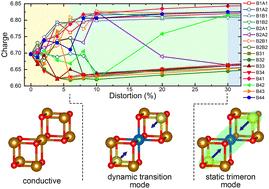
Fe3O4 undergoes a first-order metal–insulator transition, i.e., the Verwey transition at about 120 K. Despite extensive investigations focusing on the Verwey transition, the exact underlying mechanism, particularly the evolution of the electronic structure during the transition, remains debated. In this study, the lattice distortion near the Verwey transition is divided into several intermediate steps. The corresponding electronic structures and magnetic properties at each step are investigated via first-principles calculations. The results reveal that the Verwey transition can be regarded as a two-step phase transition containing a dynamic and a static trimeron network mode. Under the dynamic regime, the charge ordering pattern changes with lattice distortion. Upon further distortion, the system enters the static mode. Additionally, the variations of ferroelectricity and magnetic anisotropy with lattice distortion are investigated. The detailed calculation results may provide insights into the underlying physics of the Verwey transition and promote the understanding of the three-Fe-site trimeron unit.
期刊介绍:
Physical Chemistry Chemical Physics (PCCP) is an international journal co-owned by 19 physical chemistry and physics societies from around the world. This journal publishes original, cutting-edge research in physical chemistry, chemical physics and biophysical chemistry. To be suitable for publication in PCCP, articles must include significant innovation and/or insight into physical chemistry; this is the most important criterion that reviewers and Editors will judge against when evaluating submissions.
The journal has a broad scope and welcomes contributions spanning experiment, theory, computation and data science. Topical coverage includes spectroscopy, dynamics, kinetics, statistical mechanics, thermodynamics, electrochemistry, catalysis, surface science, quantum mechanics, quantum computing and machine learning. Interdisciplinary research areas such as polymers and soft matter, materials, nanoscience, energy, surfaces/interfaces, and biophysical chemistry are welcomed if they demonstrate significant innovation and/or insight into physical chemistry. Joined experimental/theoretical studies are particularly appreciated when complementary and based on up-to-date approaches.





 京公网安备 11010802042870号
京ICP备2023020795号-1
京公网安备 11010802042870号
京ICP备2023020795号-1
 分享
分享
 求助内容:
求助内容: 应助结果提醒方式:
 扫码关注我们