{"title":"Adaptive calibration iTMB2-iFEM for thermal-mechanical coupling deformation monitoring","authors":"Tianyu Dong , Yuanqiang Ren , Jian Chen , Wenpeng Duan","doi":"10.1016/j.ijmecsci.2026.111618","DOIUrl":null,"url":null,"abstract":"<div><div>Accurate deformation monitoring of aircraft wing beams under thermal-mechanical coupling loads is vital to flight safety and structural performance optimization. Fiber Bragg Grating (FBG) sensors combined with the inverse finite element method (iFEM) are promising for real-time strain-based deformation reconstruction. However, conventional iFEM neglects thermal-mechanical coupling, and FBG's temperature-strain cross-sensitivity degrades monitoring accuracy in practical aerospace environments. To address these issues, this study proposes an adaptive calibration iTMB2-iFEM framework for complex beam structures under thermal-mechanical coupling loads. A novel two-node inverse thermal-mechanical beam element (iTMB2) is developed, which integrates thermal-expansion degrees of freedom into the displacement-field expression of 1D inverse beam elements for synchronous reconstruction of mechanical and thermal deformation. An adaptive calibration strategy based on the Quasi-Newton method is designed to optimize the FBG strain-sensitivity coefficients by minimizing the error between the Digital Image Correlation (DIC)- measured displacement and the iTMB2-iFEM-reconstructed displacement under reference loads. Numerical simulations on a civil wing beam structure verify that the proposed iTMB2-iFEM outperforms the traditional iHB2-iFEM, with a reconstruction RMSE of 0.09 mm for thermal-mechanical coupling deformation. Experimental validation at 25 °C, 40 °C, and 60 °C with a 5 kN mechanical load shows that the adaptive calibration iTMB2-iFEM achieves a deformation reconstruction RMSE of <0.12 mm, verifying its high accuracy and engineering applicability for thermal-mechanical coupling deformation monitoring of complex beam structures.</div></div>","PeriodicalId":56287,"journal":{"name":"International Journal of Mechanical Sciences","volume":"320 ","pages":"Article 111618"},"PeriodicalIF":11.4000,"publicationDate":"2026-06-15","publicationTypes":"Journal Article","fieldsOfStudy":null,"isOpenAccess":false,"openAccessPdf":"","citationCount":"0","resultStr":null,"platform":"Semanticscholar","paperid":null,"PeriodicalName":"International Journal of Mechanical Sciences","FirstCategoryId":"5","ListUrlMain":"https://www.sciencedirect.com/science/article/pii/S0020740326004728","RegionNum":1,"RegionCategory":"工程技术","ArticlePicture":[],"TitleCN":null,"AbstractTextCN":null,"PMCID":null,"EPubDate":"2026/4/12 0:00:00","PubModel":"Epub","JCR":"Q1","JCRName":"ENGINEERING, MECHANICAL","Score":null,"Total":0}
引用次数: 0
Abstract
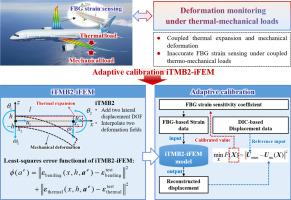
Accurate deformation monitoring of aircraft wing beams under thermal-mechanical coupling loads is vital to flight safety and structural performance optimization. Fiber Bragg Grating (FBG) sensors combined with the inverse finite element method (iFEM) are promising for real-time strain-based deformation reconstruction. However, conventional iFEM neglects thermal-mechanical coupling, and FBG's temperature-strain cross-sensitivity degrades monitoring accuracy in practical aerospace environments. To address these issues, this study proposes an adaptive calibration iTMB2-iFEM framework for complex beam structures under thermal-mechanical coupling loads. A novel two-node inverse thermal-mechanical beam element (iTMB2) is developed, which integrates thermal-expansion degrees of freedom into the displacement-field expression of 1D inverse beam elements for synchronous reconstruction of mechanical and thermal deformation. An adaptive calibration strategy based on the Quasi-Newton method is designed to optimize the FBG strain-sensitivity coefficients by minimizing the error between the Digital Image Correlation (DIC)- measured displacement and the iTMB2-iFEM-reconstructed displacement under reference loads. Numerical simulations on a civil wing beam structure verify that the proposed iTMB2-iFEM outperforms the traditional iHB2-iFEM, with a reconstruction RMSE of 0.09 mm for thermal-mechanical coupling deformation. Experimental validation at 25 °C, 40 °C, and 60 °C with a 5 kN mechanical load shows that the adaptive calibration iTMB2-iFEM achieves a deformation reconstruction RMSE of <0.12 mm, verifying its high accuracy and engineering applicability for thermal-mechanical coupling deformation monitoring of complex beam structures.
期刊介绍:
The International Journal of Mechanical Sciences (IJMS) serves as a global platform for the publication and dissemination of original research that contributes to a deeper scientific understanding of the fundamental disciplines within mechanical, civil, and material engineering.
The primary focus of IJMS is to showcase innovative and ground-breaking work that utilizes analytical and computational modeling techniques, such as Finite Element Method (FEM), Boundary Element Method (BEM), and mesh-free methods, among others. These modeling methods are applied to diverse fields including rigid-body mechanics (e.g., dynamics, vibration, stability), structural mechanics, metal forming, advanced materials (e.g., metals, composites, cellular, smart) behavior and applications, impact mechanics, strain localization, and other nonlinear effects (e.g., large deflections, plasticity, fracture).
Additionally, IJMS covers the realms of fluid mechanics (both external and internal flows), tribology, thermodynamics, and materials processing. These subjects collectively form the core of the journal's content.
In summary, IJMS provides a prestigious platform for researchers to present their original contributions, shedding light on analytical and computational modeling methods in various areas of mechanical engineering, as well as exploring the behavior and application of advanced materials, fluid mechanics, thermodynamics, and materials processing.





 京公网安备 11010802042870号
京ICP备2023020795号-1
京公网安备 11010802042870号
京ICP备2023020795号-1
 分享
分享
 求助内容:
求助内容: 应助结果提醒方式:
 扫码关注我们