Mengyi Tang, Kaifa Du, Xiang Chen, Jiajun Li, Huayi Yin, Dihua Wang
{"title":"Bulk pH-dependent failure mechanisms of transition metal anodes in seawater electrolysis","authors":"Mengyi Tang, Kaifa Du, Xiang Chen, Jiajun Li, Huayi Yin, Dihua Wang","doi":"10.1016/j.jmst.2026.03.066","DOIUrl":null,"url":null,"abstract":"Direct seawater electrolysis for hydrogen production can effectively alleviate freshwater resource constraints, but its anode stability faces severe chloride-induced corrosion. Although alkaline conditions enhance the thermodynamic selectivity of the oxygen evolution reaction (OER), the corrosion mechanism of chloride under complex bulk pH remains unclear. This study systematically investigates the electrochemical performance and failure mechanisms of four typical transition metal electrodes (FeNi36, 304SS, 316SS, NiFeO<em><sub>x</sub></em>H<em><sub>y</sub></em>) in chloride-containing electrolytes at different bulk pH (KOH concentrations, [OH⁻]). The results reveal competition between OER and metal dissolution at the anode, with the dominant pathway strongly dependent on applied potential, bulk pH, and electrode material. The galvanostatic polarization results further demonstrate that anodic failure in chloride-containing media is not a continuous dissolution process, but rather follows an “anodic deposition-mediated abrupt failure” mechanism. Cl⁻ first triggers active metal dissolution, followed by precipitation of dissolved metal ions under high bulk pH. This process is governed by the high-exponential dependence of the solubility product (<em>K</em><sub>sp</sub>) on [OH⁻]. At low bulk pH, precipitation primarily occurs in the electrolyte, forming a dense surface precipitate layer only after severe substrate corrosion. At high pH, precipitation occurs at the electrode interface, rapidly forming a dense passivation layer that causes electrode deactivation. Simultaneously, it is confirmed that the intrinsic corrosion resistance of 316SS (Mo element) and the high OER selectivity of the NiFeO<em><sub>x</sub></em>H<em><sub>y</sub></em> catalytic layer effectively extend anode service life. Overall, this study elucidates the critical role of pH in chloride-induced corrosion, providing a theoretical basis for designing highly stable seawater electrolysis anodes.","PeriodicalId":16154,"journal":{"name":"Journal of Materials Science & Technology","volume":"7 1","pages":""},"PeriodicalIF":14.3000,"publicationDate":"2026-04-10","publicationTypes":"Journal Article","fieldsOfStudy":null,"isOpenAccess":false,"openAccessPdf":"","citationCount":"0","resultStr":null,"platform":"Semanticscholar","paperid":null,"PeriodicalName":"Journal of Materials Science & Technology","FirstCategoryId":"88","ListUrlMain":"https://doi.org/10.1016/j.jmst.2026.03.066","RegionNum":1,"RegionCategory":"材料科学","ArticlePicture":[],"TitleCN":null,"AbstractTextCN":null,"PMCID":null,"EPubDate":"","PubModel":"","JCR":"Q1","JCRName":"MATERIALS SCIENCE, MULTIDISCIPLINARY","Score":null,"Total":0}
引用次数: 0
Abstract
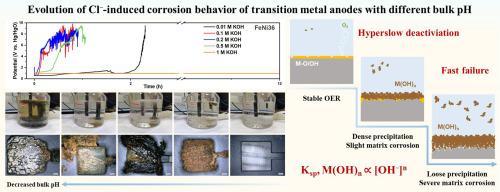
Direct seawater electrolysis for hydrogen production can effectively alleviate freshwater resource constraints, but its anode stability faces severe chloride-induced corrosion. Although alkaline conditions enhance the thermodynamic selectivity of the oxygen evolution reaction (OER), the corrosion mechanism of chloride under complex bulk pH remains unclear. This study systematically investigates the electrochemical performance and failure mechanisms of four typical transition metal electrodes (FeNi36, 304SS, 316SS, NiFeOxHy) in chloride-containing electrolytes at different bulk pH (KOH concentrations, [OH⁻]). The results reveal competition between OER and metal dissolution at the anode, with the dominant pathway strongly dependent on applied potential, bulk pH, and electrode material. The galvanostatic polarization results further demonstrate that anodic failure in chloride-containing media is not a continuous dissolution process, but rather follows an “anodic deposition-mediated abrupt failure” mechanism. Cl⁻ first triggers active metal dissolution, followed by precipitation of dissolved metal ions under high bulk pH. This process is governed by the high-exponential dependence of the solubility product (Ksp) on [OH⁻]. At low bulk pH, precipitation primarily occurs in the electrolyte, forming a dense surface precipitate layer only after severe substrate corrosion. At high pH, precipitation occurs at the electrode interface, rapidly forming a dense passivation layer that causes electrode deactivation. Simultaneously, it is confirmed that the intrinsic corrosion resistance of 316SS (Mo element) and the high OER selectivity of the NiFeOxHy catalytic layer effectively extend anode service life. Overall, this study elucidates the critical role of pH in chloride-induced corrosion, providing a theoretical basis for designing highly stable seawater electrolysis anodes.
期刊介绍:
Journal of Materials Science & Technology strives to promote global collaboration in the field of materials science and technology. It primarily publishes original research papers, invited review articles, letters, research notes, and summaries of scientific achievements. The journal covers a wide range of materials science and technology topics, including metallic materials, inorganic nonmetallic materials, and composite materials.





 京公网安备 11010802042870号
京ICP备2023020795号-1
京公网安备 11010802042870号
京ICP备2023020795号-1
 分享
分享
 求助内容:
求助内容: 应助结果提醒方式:
 扫码关注我们