Culture-dependent and culture-independent approaches to reveal the aflatoxin B1-producing fungi in Pixian Doubanjiang, a typical condiment in Chinese cuisine
Fengjiao Yang , Liang Zhang , Yuqi Zhang , Yan Zeng , Yufeng Li , Peibin Zeng
{"title":"Culture-dependent and culture-independent approaches to reveal the aflatoxin B1-producing fungi in Pixian Doubanjiang, a typical condiment in Chinese cuisine","authors":"Fengjiao Yang , Liang Zhang , Yuqi Zhang , Yan Zeng , Yufeng Li , Peibin Zeng","doi":"10.1016/j.foodcont.2023.109711","DOIUrl":null,"url":null,"abstract":"<div><p><span>In Doubanjiang (DBJ) manufacturing, fungi play a critical role in shaping the unique flavor but with the risk related to mycotoxin<span> contamination. The present study aimed to examine the occurrence of major mycotoxins and to evaluate mycotoxigenic fungi, especially aflatoxin B</span></span><sub>1</sub> (AFB<sub>1</sub><span>)- producing fungi in DBJ products. A total of 150 samples were detected to report the occurrence of four aflatoxins (AFs) and ochratoxin A (OTA) by high performance liquid chromatography (HPLC) coupled with a fluorescence detector. The potential mycotoxin-producing fungi were isolated from AFB</span><sub>1</sub> positive samples and underwent morphological and molecular identifications. Then, the capabilities of <span><em>Aspergillus</em><em> flavus</em></span> isolates in producing AFB<sub>1</sub> were evaluated using real-time PCR and HPLC. Meanwhile, the fungal communities of AFB<sub>1</sub> positive and negative samples were compared by next generation sequencing (NGS). In our study, the positive rates for AFB<sub>1</sub>, AFG<sub>1</sub>, AFB<sub>2</sub>, AFG<sub>2</sub>, and OTA among DBJ samples were at: 34.0%, 21.3%, 36.7%, 11.3% and 11.3%, respectively. A total of 20 <em>A. flavus</em> were isolated from DBJ samples, and 65% (n = 13) were verified to produce AFB<sub>1</sub>. The NGS results have shown that the abundance of <em>Aspergillus</em> and <em>A. flavus</em> was significantly higher in AFB<sub>1</sub> positive samples. The findings in our study jointly suggest that <em>A. flavus</em> is the core AFB<sub>1</sub>-producing fungus in DBJ manufacturing.</p></div>","PeriodicalId":319,"journal":{"name":"Food Control","volume":"149 ","pages":"Article 109711"},"PeriodicalIF":6.3000,"publicationDate":"2023-07-01","publicationTypes":"Journal Article","fieldsOfStudy":null,"isOpenAccess":false,"openAccessPdf":"","citationCount":"0","resultStr":null,"platform":"Semanticscholar","paperid":null,"PeriodicalName":"Food Control","FirstCategoryId":"97","ListUrlMain":"https://www.sciencedirect.com/science/article/pii/S0956713523001111","RegionNum":1,"RegionCategory":"农林科学","ArticlePicture":[],"TitleCN":null,"AbstractTextCN":null,"PMCID":null,"EPubDate":"2023/2/24 0:00:00","PubModel":"Epub","JCR":"Q1","JCRName":"FOOD SCIENCE & TECHNOLOGY","Score":null,"Total":0}
引用次数: 0
Abstract
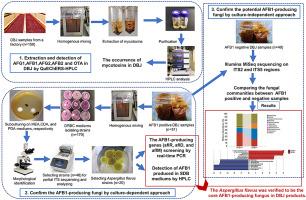
In Doubanjiang (DBJ) manufacturing, fungi play a critical role in shaping the unique flavor but with the risk related to mycotoxin contamination. The present study aimed to examine the occurrence of major mycotoxins and to evaluate mycotoxigenic fungi, especially aflatoxin B1 (AFB1)- producing fungi in DBJ products. A total of 150 samples were detected to report the occurrence of four aflatoxins (AFs) and ochratoxin A (OTA) by high performance liquid chromatography (HPLC) coupled with a fluorescence detector. The potential mycotoxin-producing fungi were isolated from AFB1 positive samples and underwent morphological and molecular identifications. Then, the capabilities of Aspergillus flavus isolates in producing AFB1 were evaluated using real-time PCR and HPLC. Meanwhile, the fungal communities of AFB1 positive and negative samples were compared by next generation sequencing (NGS). In our study, the positive rates for AFB1, AFG1, AFB2, AFG2, and OTA among DBJ samples were at: 34.0%, 21.3%, 36.7%, 11.3% and 11.3%, respectively. A total of 20 A. flavus were isolated from DBJ samples, and 65% (n = 13) were verified to produce AFB1. The NGS results have shown that the abundance of Aspergillus and A. flavus was significantly higher in AFB1 positive samples. The findings in our study jointly suggest that A. flavus is the core AFB1-producing fungus in DBJ manufacturing.
期刊介绍:
Food Control is an international journal that provides essential information for those involved in food safety and process control.
Food Control covers the below areas that relate to food process control or to food safety of human foods:
• Microbial food safety and antimicrobial systems
• Mycotoxins
• Hazard analysis, HACCP and food safety objectives
• Risk assessment, including microbial and chemical hazards
• Quality assurance
• Good manufacturing practices
• Food process systems design and control
• Food Packaging technology and materials in contact with foods
• Rapid methods of analysis and detection, including sensor technology
• Codes of practice, legislation and international harmonization
• Consumer issues
• Education, training and research needs.
The scope of Food Control is comprehensive and includes original research papers, authoritative reviews, short communications, comment articles that report on new developments in food control, and position papers.





 京公网安备 11010802042870号
京ICP备2023020795号-1
京公网安备 11010802042870号
京ICP备2023020795号-1
 分享
分享
 求助内容:
求助内容: 应助结果提醒方式:
 扫码关注我们