Xiaojia Yan , Cuicui Ma , Fengzhan Cui , David Julian McClements , Xuebo Liu , Fuguo Liu
{"title":"Protein-stabilized Pickering emulsions: Formation, stability, properties, and applications in foods","authors":"Xiaojia Yan , Cuicui Ma , Fengzhan Cui , David Julian McClements , Xuebo Liu , Fuguo Liu","doi":"10.1016/j.tifs.2020.07.005","DOIUrl":null,"url":null,"abstract":"<div><h3>Background</h3><p>Pickering emulsions prepared using food-grade colloidal particles can be designed to have high physical stability, tunable textural attributes, and good loading/release properties. Protein-based colloidal particles are particularly suitable for this purpose because they are widely available, inexpensive, have good emulsifying properties, and nutritional benefits.</p></div><div><h3>Scope and approach</h3><p>This paper reviews the stabilization mechanisms of Pickering emulsions, then summarizes the preparation, properties, and applications of protein-stabilized Pickering emulsions, focusing on protein nanoparticles, microgels, and fibrils. The challenges of utilizing protein-based Pickering emulsions in the food industry are also discussed.</p></div><div><h3>Key findings and conclusions</h3><p><span>At present, there are three main types of mechanisms responsible for stabilizing Pickering emulsion using proteins: (i) formation of a solid particle coating at the interface; (ii) formation of a three-dimensional viscoelastic particle network in the continuous phase; (iii) depletion stabilization. Each of these mechanisms has its own advantages and disadvantages, and selecting the most appropriate one (or combination) depends on the application requirements of the Pickering emulsion. Currently, the most common applications of protein-stabilized Pickering emulsions in the food industry are: formulation of spread-like products (like margarine); encapsulation of bioactive components; and, protection of lipids against </span>oxidation.</p></div>","PeriodicalId":441,"journal":{"name":"Trends in Food Science & Technology","volume":"103 ","pages":"Pages 293-303"},"PeriodicalIF":17.4000,"publicationDate":"2020-09-01","publicationTypes":"Journal Article","fieldsOfStudy":null,"isOpenAccess":false,"openAccessPdf":"https://sci-hub-pdf.com/10.1016/j.tifs.2020.07.005","citationCount":"153","resultStr":null,"platform":"Semanticscholar","paperid":null,"PeriodicalName":"Trends in Food Science & Technology","FirstCategoryId":"97","ListUrlMain":"https://www.sciencedirect.com/science/article/pii/S0924224420305331","RegionNum":1,"RegionCategory":"农林科学","ArticlePicture":[],"TitleCN":null,"AbstractTextCN":null,"PMCID":null,"EPubDate":"2020/7/22 0:00:00","PubModel":"Epub","JCR":"Q1","JCRName":"FOOD SCIENCE & TECHNOLOGY","Score":null,"Total":0}
引用次数: 153
Abstract
Background
Pickering emulsions prepared using food-grade colloidal particles can be designed to have high physical stability, tunable textural attributes, and good loading/release properties. Protein-based colloidal particles are particularly suitable for this purpose because they are widely available, inexpensive, have good emulsifying properties, and nutritional benefits.
Scope and approach
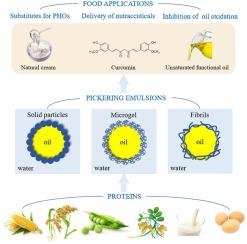
This paper reviews the stabilization mechanisms of Pickering emulsions, then summarizes the preparation, properties, and applications of protein-stabilized Pickering emulsions, focusing on protein nanoparticles, microgels, and fibrils. The challenges of utilizing protein-based Pickering emulsions in the food industry are also discussed.
Key findings and conclusions
At present, there are three main types of mechanisms responsible for stabilizing Pickering emulsion using proteins: (i) formation of a solid particle coating at the interface; (ii) formation of a three-dimensional viscoelastic particle network in the continuous phase; (iii) depletion stabilization. Each of these mechanisms has its own advantages and disadvantages, and selecting the most appropriate one (or combination) depends on the application requirements of the Pickering emulsion. Currently, the most common applications of protein-stabilized Pickering emulsions in the food industry are: formulation of spread-like products (like margarine); encapsulation of bioactive components; and, protection of lipids against oxidation.
期刊介绍:
Trends in Food Science & Technology is a prestigious international journal that specializes in peer-reviewed articles covering the latest advancements in technology, food science, and human nutrition. It serves as a bridge between specialized primary journals and general trade magazines, providing readable and scientifically rigorous reviews and commentaries on current research developments and their potential applications in the food industry.
Unlike traditional journals, Trends in Food Science & Technology does not publish original research papers. Instead, it focuses on critical and comprehensive reviews to offer valuable insights for professionals in the field. By bringing together cutting-edge research and industry applications, this journal plays a vital role in disseminating knowledge and facilitating advancements in the food science and technology sector.





 京公网安备 11010802042870号
京ICP备2023020795号-1
京公网安备 11010802042870号
京ICP备2023020795号-1
 分享
分享
 求助内容:
求助内容: 应助结果提醒方式:
 扫码关注我们