Karrie A. Weber, Laurie A. Achenbach, John D. Coates
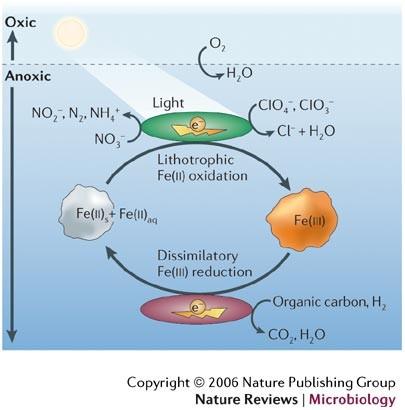
{"title":"Microorganisms pumping iron: anaerobic microbial iron oxidation and reduction","authors":"Karrie A. Weber, Laurie A. Achenbach, John D. Coates","doi":"10.1038/nrmicro1490","DOIUrl":null,"url":null,"abstract":"Anaerobic microbial iron oxidation and reduction contributes significantly to soil and sediment biogeochemistry and mineralogy in anaerobic environments. Here, Weber and colleagues review the diversity of microorganisms involved in these processes, and the unique biochemical challenges associated with utilizing an insoluble metal substrate. Iron (Fe) has long been a recognized physiological requirement for life, yet for many microorganisms that persist in water, soils and sediments, its role extends well beyond that of a nutritional necessity. Fe(II) can function as an electron source for iron-oxidizing microorganisms under both oxic and anoxic conditions and Fe(III) can function as a terminal electron acceptor under anoxic conditions for iron-reducing microorganisms. Given that iron is the fourth most abundant element in the Earth''s crust, iron redox reactions have the potential to support substantial microbial populations in soil and sedimentary environments. As such, biological iron apportionment has been described as one of the most ancient forms of microbial metabolism on Earth, and as a conceivable extraterrestrial metabolism on other iron-mineral-rich planets such as Mars. Furthermore, the metabolic versatility of the microorganisms involved in these reactions has resulted in the development of biotechnological applications to remediate contaminated environments and harvest energy.","PeriodicalId":18838,"journal":{"name":"Nature Reviews Microbiology","volume":"4 10","pages":"752-764"},"PeriodicalIF":104.6000,"publicationDate":"2006-10-01","publicationTypes":"Journal Article","fieldsOfStudy":null,"isOpenAccess":false,"openAccessPdf":"https://sci-hub-pdf.com/10.1038/nrmicro1490","citationCount":"1384","resultStr":null,"platform":"Semanticscholar","paperid":null,"PeriodicalName":"Nature Reviews Microbiology","FirstCategoryId":"99","ListUrlMain":"https://www.nature.com/articles/nrmicro1490","RegionNum":1,"RegionCategory":"生物学","ArticlePicture":[],"TitleCN":null,"AbstractTextCN":null,"PMCID":null,"EPubDate":"","PubModel":"","JCR":"Q1","JCRName":"MICROBIOLOGY","Score":null,"Total":0}
引用次数: 1384
Abstract
Anaerobic microbial iron oxidation and reduction contributes significantly to soil and sediment biogeochemistry and mineralogy in anaerobic environments. Here, Weber and colleagues review the diversity of microorganisms involved in these processes, and the unique biochemical challenges associated with utilizing an insoluble metal substrate. Iron (Fe) has long been a recognized physiological requirement for life, yet for many microorganisms that persist in water, soils and sediments, its role extends well beyond that of a nutritional necessity. Fe(II) can function as an electron source for iron-oxidizing microorganisms under both oxic and anoxic conditions and Fe(III) can function as a terminal electron acceptor under anoxic conditions for iron-reducing microorganisms. Given that iron is the fourth most abundant element in the Earth''s crust, iron redox reactions have the potential to support substantial microbial populations in soil and sedimentary environments. As such, biological iron apportionment has been described as one of the most ancient forms of microbial metabolism on Earth, and as a conceivable extraterrestrial metabolism on other iron-mineral-rich planets such as Mars. Furthermore, the metabolic versatility of the microorganisms involved in these reactions has resulted in the development of biotechnological applications to remediate contaminated environments and harvest energy.
期刊介绍:
At Nature Reviews Microbiology, our goal is to become the leading source of reviews and commentaries for the scientific community we cater to. We are dedicated to publishing articles that are not only authoritative but also easily accessible, supplementing them with clear and concise figures, tables, and other visual aids. Our objective is to offer an unparalleled service to authors, referees, and readers, and we continuously strive to maximize the usefulness and impact of each article we publish. With a focus on Reviews, Perspectives, and Comments spanning the entire field of microbiology, our wide scope ensures that the work we feature reaches the widest possible audience.




 京公网安备 11010802042870号
京ICP备2023020795号-1
京公网安备 11010802042870号
京ICP备2023020795号-1
 分享
分享
 求助内容:
求助内容: 应助结果提醒方式:
 扫码关注我们