Diana M Matthe, Oana-Maria Thoma, Tobias Sperka, Markus F Neurath, Maximilian J Waldner
{"title":"Telomerase deficiency reflects age-associated changes in CD4+ T cells.","authors":"Diana M Matthe, Oana-Maria Thoma, Tobias Sperka, Markus F Neurath, Maximilian J Waldner","doi":"10.1186/s12979-022-00273-0","DOIUrl":null,"url":null,"abstract":"<p><strong>Background: </strong>Amongst other systemic changes, aging leads to an immune dysfunction. On the molecular level, a hallmark of aging is telomere shortening. The functional relevance of telomerase, an enzyme capable of elongating telomeres in T cells upon antigen stimulation, is not fully understood. Studying the impact of telomere shortening on CD4+ T cells and especially Th1 effector function can provide a better understanding on immune dysfunctions in elderly.</p><p><strong>Results: </strong>We investigated T cell numbers and differentiation in telomerase-deficient (mTerc-/-) mice under steady-state conditions and the functional role of telomerase in CD4+ T cells using in vitro stimulation and Th1 polarization protocols by comparing T cells from mTerc-/- and control mice. We report reduced relative CD4+ T cell numbers in blood and secondary lymphoid organs and a relative decline in the naïve T cell population in thymus, blood and spleen of mTerc-/- mice compared to control mice. Importantly, after in vitro polarization, mTerc-/- G3 CD4+ T cells showed higher numbers of IFNγ-producing cells and reduced expression of CD28. Notably, telomerase-deficient T cells were more susceptible to inhibition of Th1 polarization by IL-6 in vitro. These results demonstrate that telomerase deficiency recapitulates several changes of CD4+ T cells seen in aged humans regarding the naïve T cell population, expression of CD28 and cytokine production.</p><p><strong>Conclusion: </strong>Our data suggest that telomere shortening could play a key role in the aging of T cell immunity, with clinical implications for immune diseases and tumor development and that mTerc-/- mice are a suitable model to study aging-related defects of adaptive immunity.</p>","PeriodicalId":367404,"journal":{"name":"Immunity & Ageing : I & A","volume":" ","pages":"16"},"PeriodicalIF":0.0000,"publicationDate":"2022-03-23","publicationTypes":"Journal Article","fieldsOfStudy":null,"isOpenAccess":false,"openAccessPdf":"https://www.ncbi.nlm.nih.gov/pmc/articles/PMC8941756/pdf/","citationCount":"7","resultStr":null,"platform":"Semanticscholar","paperid":null,"PeriodicalName":"Immunity & Ageing : I & A","FirstCategoryId":"3","ListUrlMain":"https://doi.org/10.1186/s12979-022-00273-0","RegionNum":0,"RegionCategory":null,"ArticlePicture":[],"TitleCN":null,"AbstractTextCN":null,"PMCID":null,"EPubDate":"","PubModel":"","JCR":"","JCRName":"","Score":null,"Total":0}
引用次数: 7
Abstract
Background: Amongst other systemic changes, aging leads to an immune dysfunction. On the molecular level, a hallmark of aging is telomere shortening. The functional relevance of telomerase, an enzyme capable of elongating telomeres in T cells upon antigen stimulation, is not fully understood. Studying the impact of telomere shortening on CD4+ T cells and especially Th1 effector function can provide a better understanding on immune dysfunctions in elderly.
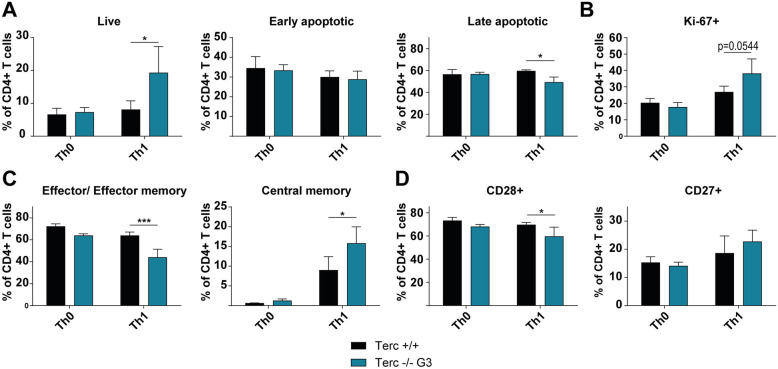
Results: We investigated T cell numbers and differentiation in telomerase-deficient (mTerc-/-) mice under steady-state conditions and the functional role of telomerase in CD4+ T cells using in vitro stimulation and Th1 polarization protocols by comparing T cells from mTerc-/- and control mice. We report reduced relative CD4+ T cell numbers in blood and secondary lymphoid organs and a relative decline in the naïve T cell population in thymus, blood and spleen of mTerc-/- mice compared to control mice. Importantly, after in vitro polarization, mTerc-/- G3 CD4+ T cells showed higher numbers of IFNγ-producing cells and reduced expression of CD28. Notably, telomerase-deficient T cells were more susceptible to inhibition of Th1 polarization by IL-6 in vitro. These results demonstrate that telomerase deficiency recapitulates several changes of CD4+ T cells seen in aged humans regarding the naïve T cell population, expression of CD28 and cytokine production.
Conclusion: Our data suggest that telomere shortening could play a key role in the aging of T cell immunity, with clinical implications for immune diseases and tumor development and that mTerc-/- mice are a suitable model to study aging-related defects of adaptive immunity.





 京公网安备 11010802042870号
京ICP备2023020795号-1
京公网安备 11010802042870号
京ICP备2023020795号-1
 分享
分享

 求助内容:
求助内容: 应助结果提醒方式:
 扫码关注我们