{"title":"Equine Stomach Development in the Fetal Period: An Anatomical, Topographical, and Morphometric Study.","authors":"Dominik Poradowski, Aleksander Chrószcz","doi":"10.3390/ani12212966","DOIUrl":null,"url":null,"abstract":"<p><p>Studies of equine stomach prenatal development are very rare, and descriptions usually focus on the processes taking place in the embryonic period. Only general information about gastric organogenesis in the fetal period is available in embryology textbooks on domestic mammals. The material for our study included twenty half-breed horse fetuses divided into three age groups on the basis of known fetal age (verified using the CRL method). Our study consists of the topographical, morphological, and morphometrical description of stomach development between the 4th and 11th months of gestation. Even though the skeletotopy, syntopy, and holotopy of the stomach in the fetal period seems to be relatively unchanged, the organ shape and the proportions between its anatomical parts differed in fetuses from the three age groups. The achieved results were statistically elaborated to estimate the dynamics of the stomach shape. This can be described as changing from medium-wide to wide and from slightly bent to sharply bent. A nonlinear correlation of all metric values with CRL in all age groups was observed. A positive allometric growth rate of different intensity was seen in all metric parameters. All the values increased as the fetal period progressed. Only the parietal surface growth rate gradually changed from strongly positive allometric in the first age group to strongly negative allometric in the third age group. A difference between the non-glandular and glandular mucosa of the stomach was visible in the first group. Development of a well-distinguishable plicated edge margin began in the second age group together with gastric pits and gastric areas. The third age group showed a well-developed gastric groove and angular incisura.</p>","PeriodicalId":519482,"journal":{"name":"Animals : an Open Access Journal from MDPI","volume":" ","pages":""},"PeriodicalIF":0.0000,"publicationDate":"2022-10-28","publicationTypes":"Journal Article","fieldsOfStudy":null,"isOpenAccess":false,"openAccessPdf":"https://www.ncbi.nlm.nih.gov/pmc/articles/PMC9658733/pdf/","citationCount":"2","resultStr":null,"platform":"Semanticscholar","paperid":null,"PeriodicalName":"Animals : an Open Access Journal from MDPI","FirstCategoryId":"97","ListUrlMain":"https://doi.org/10.3390/ani12212966","RegionNum":0,"RegionCategory":null,"ArticlePicture":[],"TitleCN":null,"AbstractTextCN":null,"PMCID":null,"EPubDate":"","PubModel":"","JCR":"","JCRName":"","Score":null,"Total":0}
引用次数: 2
Abstract
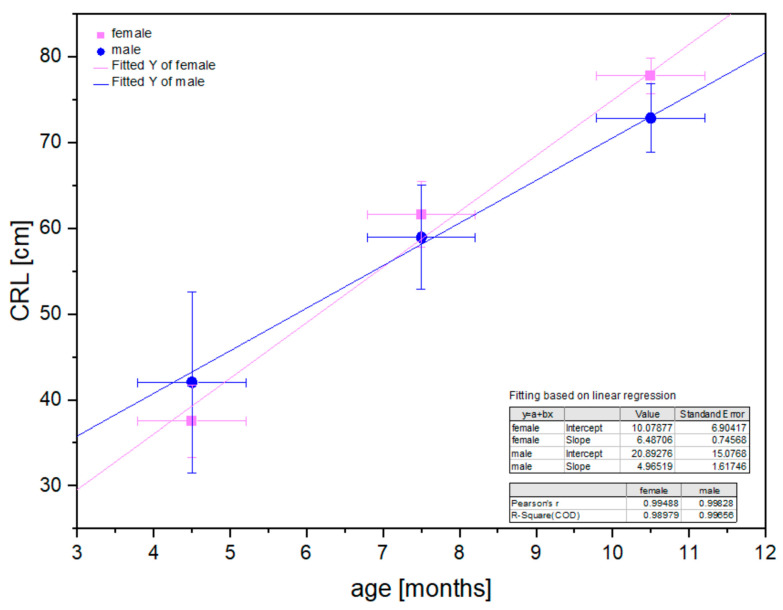
Studies of equine stomach prenatal development are very rare, and descriptions usually focus on the processes taking place in the embryonic period. Only general information about gastric organogenesis in the fetal period is available in embryology textbooks on domestic mammals. The material for our study included twenty half-breed horse fetuses divided into three age groups on the basis of known fetal age (verified using the CRL method). Our study consists of the topographical, morphological, and morphometrical description of stomach development between the 4th and 11th months of gestation. Even though the skeletotopy, syntopy, and holotopy of the stomach in the fetal period seems to be relatively unchanged, the organ shape and the proportions between its anatomical parts differed in fetuses from the three age groups. The achieved results were statistically elaborated to estimate the dynamics of the stomach shape. This can be described as changing from medium-wide to wide and from slightly bent to sharply bent. A nonlinear correlation of all metric values with CRL in all age groups was observed. A positive allometric growth rate of different intensity was seen in all metric parameters. All the values increased as the fetal period progressed. Only the parietal surface growth rate gradually changed from strongly positive allometric in the first age group to strongly negative allometric in the third age group. A difference between the non-glandular and glandular mucosa of the stomach was visible in the first group. Development of a well-distinguishable plicated edge margin began in the second age group together with gastric pits and gastric areas. The third age group showed a well-developed gastric groove and angular incisura.





 京公网安备 11010802042870号
京ICP备2023020795号-1
 分享

 求助内容:
 应助结果提醒方式:
 扫码关注我们
