A.J. Buttress , G. Hargreaves , A. Ilchev , T. Monti , A. Sklavounou , J. Katrib , P. Martin-Tanchereau , M.G. Unthank , D.J. Irvine , C.D. Dodds
{"title":"Design and optimisation of a microwave reactor for kilo-scale polymer synthesis","authors":"A.J. Buttress , G. Hargreaves , A. Ilchev , T. Monti , A. Sklavounou , J. Katrib , P. Martin-Tanchereau , M.G. Unthank , D.J. Irvine , C.D. Dodds","doi":"10.1016/j.cesx.2019.100022","DOIUrl":null,"url":null,"abstract":"<div><p>Current industrial production of polymer resins is generally undertaken in large multi-tonne stirred tank reactors. These are characterised by relatively slow heating and cooling cycles, resulting in long vessel cycle times and extended production campaigns. In this work we present a design for a hybrid microwave/oil jacket proof of concept system capable of producing up to 4.1 kg of polymer resin per batch. By exploiting rapid volumetric heating effects of microwave energy at 2.45 GHz, we have optimised the synthetic regime, such that a 3.7 kg batch of polyester resin pre-polymer can be made in only 8 h 20 min, with higher molecular weight (M<sub>n</sub> 2100) compared to the conventional process taking 22 h 15 min (M<sub>n</sub> 1200), yielding an increase in synthesis rate of at least 265%. The increase in polymer molecular weight also suggests a higher conversion was achieved over a shorter time scale.</p></div>","PeriodicalId":37148,"journal":{"name":"Chemical Engineering Science: X","volume":"2 ","pages":"Article 100022"},"PeriodicalIF":0.0000,"publicationDate":"2019-05-01","publicationTypes":"Journal Article","fieldsOfStudy":null,"isOpenAccess":false,"openAccessPdf":"https://sci-hub-pdf.com/10.1016/j.cesx.2019.100022","citationCount":"8","resultStr":null,"platform":"Semanticscholar","paperid":null,"PeriodicalName":"Chemical Engineering Science: X","FirstCategoryId":"1085","ListUrlMain":"https://www.sciencedirect.com/science/article/pii/S2590140019300292","RegionNum":0,"RegionCategory":null,"ArticlePicture":[],"TitleCN":null,"AbstractTextCN":null,"PMCID":null,"EPubDate":"2019/4/6 0:00:00","PubModel":"Epub","JCR":"Q1","JCRName":"Engineering","Score":null,"Total":0}
引用次数: 8
Abstract
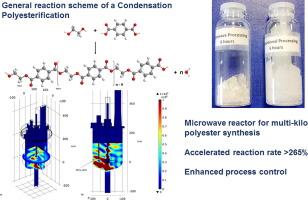
Current industrial production of polymer resins is generally undertaken in large multi-tonne stirred tank reactors. These are characterised by relatively slow heating and cooling cycles, resulting in long vessel cycle times and extended production campaigns. In this work we present a design for a hybrid microwave/oil jacket proof of concept system capable of producing up to 4.1 kg of polymer resin per batch. By exploiting rapid volumetric heating effects of microwave energy at 2.45 GHz, we have optimised the synthetic regime, such that a 3.7 kg batch of polyester resin pre-polymer can be made in only 8 h 20 min, with higher molecular weight (Mn 2100) compared to the conventional process taking 22 h 15 min (Mn 1200), yielding an increase in synthesis rate of at least 265%. The increase in polymer molecular weight also suggests a higher conversion was achieved over a shorter time scale.
目前聚合物树脂的工业生产一般在大型多吨搅拌槽式反应器中进行。其特点是加热和冷却周期相对较慢,导致容器周期时间长,生产周期延长。在这项工作中,我们提出了一种混合微波/油套概念验证系统的设计,该系统能够每批生产高达4.1 kg的聚合物树脂。通过利用微波能量在2.45 GHz下的快速体积加热效应,我们优化了合成方案,这样3.7 kg的聚酯树脂预聚物批次可以在8 h 20 min内制成,与传统工艺需要22 h 15 min (Mn 1200)相比,具有更高的分子量(Mn 2100),合成率至少增加265%。聚合物分子量的增加也表明在更短的时间内实现了更高的转化率。





 京公网安备 11010802042870号
京ICP备2023020795号-1
京公网安备 11010802042870号
京ICP备2023020795号-1
 分享
分享
 求助内容:
求助内容: 应助结果提醒方式:
 扫码关注我们