Wenlong Cai, Yan Deng, Zhiwen Deng, Ye Jia, Zeheng Li, Xuemei Zhang, Changhaoyue Xu, Xue-Qiang Zhang, Yun Zhang, Qiang Zhang
{"title":"Quasi-Localized High-Concentration Electrolytes for High-Voltage Lithium Metal Batteries","authors":"Wenlong Cai, Yan Deng, Zhiwen Deng, Ye Jia, Zeheng Li, Xuemei Zhang, Changhaoyue Xu, Xue-Qiang Zhang, Yun Zhang, Qiang Zhang","doi":"10.1002/aenm.202301396","DOIUrl":null,"url":null,"abstract":"<p>The poor compatibility with Li metal and electrolyte oxidation stability preclude the utilization of commercial ester-based electrolytes for high-voltage lithium metal batteries. This work proposes a quasi-localized high-concentration electrolyte (<i>q-</i>LHCE) by partially replacing solvents in conventional LiPF<sub>6</sub> based carbonated electrolyte with fluorinated analogs (fluoroethylene carbonate (FEC), 2,2,2-trifluoroethyl methyl carbonate (FEMC)) with weakly-solvating ability. The <i>q-</i>LHCE enables the formation of an anion-rich solvation sheath, which functions like LHCE but differs in the partial participation of weakly-solvating cosolvent in the solvation structure. With this optimized electrolyte, inorganic-dominated solid electrolyte interphases are achieved on both the cathode and anode, leading to uniform Li deposition, suppressed electrolyte decomposition and cathode deterioration. Consequently, <i>q-</i>LHCE supports stable cycling of Li | LiCoO<sub>2</sub> (≈3.5 mAh cm<sup>−2</sup>) cells at 4.5 V under the whole climate range (from −20 to 45 °C) with limited Li consumption. A practical ampere-hour level graphite | LiCoO<sub>2</sub> pouch cell at 4.5 V and aggressive Li | LiNi<sub>0.5</sub>Mn<sub>1.5</sub>O<sub>4</sub> cell at 5.0 V with excellent capacity retention further reveals the effectiveness of <i>q-</i>LHCE. The refinement of old-fashioned carbonate electrolytes provides new perspectives toward practical high-voltage battery systems.</p>","PeriodicalId":111,"journal":{"name":"Advanced Energy Materials","volume":"13 31","pages":""},"PeriodicalIF":26.0000,"publicationDate":"2023-06-27","publicationTypes":"Journal Article","fieldsOfStudy":null,"isOpenAccess":false,"openAccessPdf":"","citationCount":"5","resultStr":null,"platform":"Semanticscholar","paperid":null,"PeriodicalName":"Advanced Energy Materials","FirstCategoryId":"88","ListUrlMain":"https://onlinelibrary.wiley.com/doi/10.1002/aenm.202301396","RegionNum":1,"RegionCategory":"材料科学","ArticlePicture":[],"TitleCN":null,"AbstractTextCN":null,"PMCID":null,"EPubDate":"","PubModel":"","JCR":"Q1","JCRName":"CHEMISTRY, PHYSICAL","Score":null,"Total":0}
引用次数: 5
Abstract
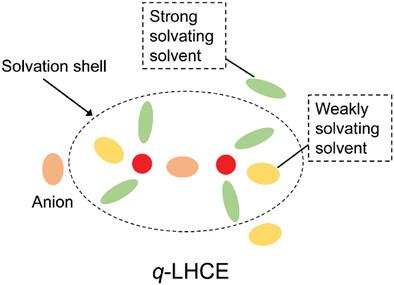
The poor compatibility with Li metal and electrolyte oxidation stability preclude the utilization of commercial ester-based electrolytes for high-voltage lithium metal batteries. This work proposes a quasi-localized high-concentration electrolyte (q-LHCE) by partially replacing solvents in conventional LiPF6 based carbonated electrolyte with fluorinated analogs (fluoroethylene carbonate (FEC), 2,2,2-trifluoroethyl methyl carbonate (FEMC)) with weakly-solvating ability. The q-LHCE enables the formation of an anion-rich solvation sheath, which functions like LHCE but differs in the partial participation of weakly-solvating cosolvent in the solvation structure. With this optimized electrolyte, inorganic-dominated solid electrolyte interphases are achieved on both the cathode and anode, leading to uniform Li deposition, suppressed electrolyte decomposition and cathode deterioration. Consequently, q-LHCE supports stable cycling of Li | LiCoO2 (≈3.5 mAh cm−2) cells at 4.5 V under the whole climate range (from −20 to 45 °C) with limited Li consumption. A practical ampere-hour level graphite | LiCoO2 pouch cell at 4.5 V and aggressive Li | LiNi0.5Mn1.5O4 cell at 5.0 V with excellent capacity retention further reveals the effectiveness of q-LHCE. The refinement of old-fashioned carbonate electrolytes provides new perspectives toward practical high-voltage battery systems.
期刊介绍:
Established in 2011, Advanced Energy Materials is an international, interdisciplinary, English-language journal that focuses on materials used in energy harvesting, conversion, and storage. It is regarded as a top-quality journal alongside Advanced Materials, Advanced Functional Materials, and Small.
With a 2022 Impact Factor of 27.8, Advanced Energy Materials is considered a prime source for the best energy-related research. The journal covers a wide range of topics in energy-related research, including organic and inorganic photovoltaics, batteries and supercapacitors, fuel cells, hydrogen generation and storage, thermoelectrics, water splitting and photocatalysis, solar fuels and thermosolar power, magnetocalorics, and piezoelectronics.
The readership of Advanced Energy Materials includes materials scientists, chemists, physicists, and engineers in both academia and industry. The journal is indexed in various databases and collections, such as Advanced Technologies & Aerospace Database, FIZ Karlsruhe, INSPEC (IET), Science Citation Index Expanded, Technology Collection, and Web of Science, among others.





 京公网安备 11010802042870号
京ICP备2023020795号-1
京公网安备 11010802042870号
京ICP备2023020795号-1
 分享
分享
 求助内容:
求助内容: 应助结果提醒方式:
 扫码关注我们