{"title":"A case report: Masson's tumor (intravascular papillary endothelial hyperplasia) of the abdominal cavity.","authors":"Yiran Ren, Xiangrong Yu","doi":"10.21037/jgo-2025-635","DOIUrl":null,"url":null,"abstract":"<p><strong>Background: </strong>Masson's tumor, also known as intravascular papillary endothelial hyperplasia (IPEH), is a rare benign vascular lesion that can arise in a wide range of anatomical sites, most frequently within the dermis and subcutaneous tissues. Because its clinical manifestations and radiological appearances are nonspecific and may closely mimic those of malignant vascular neoplasms or soft-tissue sarcomas, it is frequently misinterpreted as a malignant tumor, particularly in the preoperative setting. To draw attention to this important diagnostic pitfall, we present a case of IPEH that was initially misdiagnosed as a malignant lesion, with the aim of improving recognition of its characteristic features and thereby enhancing diagnostic accuracy and reducing the likelihood of future misdiagnosis.</p><p><strong>Case description: </strong>A 52-year-old woman was incidentally found to have a well-circumscribed, hypervascular intra-abdominal mass during a chest computed tomography (CT) scan. Magnetic resonance imaging showed a T1-hypointense/T2-hyperintense lesion with restricted diffusion and progressive enhancement. Given its marked hypervascularity and intra-abdominal location, a neoplastic process was initially suspected. However, following surgical exploration with complete excision of the mass and histopathological evaluation, the lesion was ultimately diagnosed as IPEH.</p><p><strong>Conclusions: </strong>Intra-abdominal Masson's tumor is exceedingly rare, and its imaging characteristics have not been systematically defined. In this report, we describe a surgically confirmed case of intra-abdominal Masson's tumor and place particular emphasis on its radiological features, including a well-circumscribed hyper vascular mass with progressive enhancement but without overt signs of malignancy. Despite these suggestive imaging findings, the definitive diagnosis continues to depend on histopathological assessment combined with immunohistochemical staining. By presenting this case, we hope to raise awareness of this benign yet deceptive vascular lesion and highlight that a pattern of progressive enhancement in the absence of malignant imaging features may prompt consideration of Masson's tumor in the differential diagnosis, thereby facilitating earlier and more accurate diagnosis.</p>","PeriodicalId":15841,"journal":{"name":"Journal of gastrointestinal oncology","volume":"17 1","pages":"33"},"PeriodicalIF":2.0000,"publicationDate":"2026-02-28","publicationTypes":"Journal Article","fieldsOfStudy":null,"isOpenAccess":false,"openAccessPdf":"https://www.ncbi.nlm.nih.gov/pmc/articles/PMC12972037/pdf/","citationCount":"0","resultStr":null,"platform":"Semanticscholar","paperid":null,"PeriodicalName":"Journal of gastrointestinal oncology","FirstCategoryId":"3","ListUrlMain":"https://doi.org/10.21037/jgo-2025-635","RegionNum":4,"RegionCategory":"医学","ArticlePicture":[],"TitleCN":null,"AbstractTextCN":null,"PMCID":null,"EPubDate":"2026/1/16 0:00:00","PubModel":"Epub","JCR":"Q3","JCRName":"GASTROENTEROLOGY & HEPATOLOGY","Score":null,"Total":0}
引用次数: 0
Abstract
Background: Masson's tumor, also known as intravascular papillary endothelial hyperplasia (IPEH), is a rare benign vascular lesion that can arise in a wide range of anatomical sites, most frequently within the dermis and subcutaneous tissues. Because its clinical manifestations and radiological appearances are nonspecific and may closely mimic those of malignant vascular neoplasms or soft-tissue sarcomas, it is frequently misinterpreted as a malignant tumor, particularly in the preoperative setting. To draw attention to this important diagnostic pitfall, we present a case of IPEH that was initially misdiagnosed as a malignant lesion, with the aim of improving recognition of its characteristic features and thereby enhancing diagnostic accuracy and reducing the likelihood of future misdiagnosis.
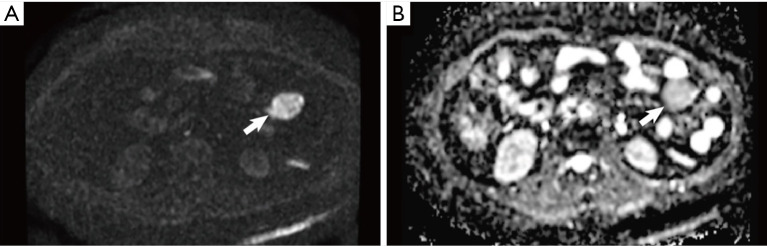
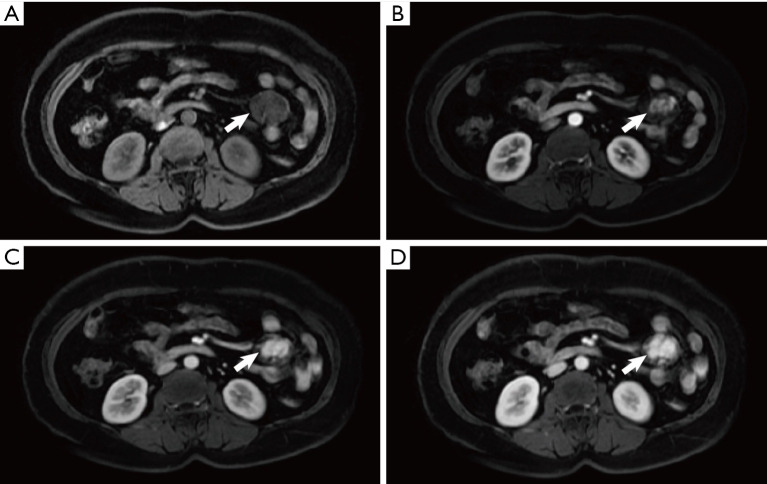
Case description: A 52-year-old woman was incidentally found to have a well-circumscribed, hypervascular intra-abdominal mass during a chest computed tomography (CT) scan. Magnetic resonance imaging showed a T1-hypointense/T2-hyperintense lesion with restricted diffusion and progressive enhancement. Given its marked hypervascularity and intra-abdominal location, a neoplastic process was initially suspected. However, following surgical exploration with complete excision of the mass and histopathological evaluation, the lesion was ultimately diagnosed as IPEH.
Conclusions: Intra-abdominal Masson's tumor is exceedingly rare, and its imaging characteristics have not been systematically defined. In this report, we describe a surgically confirmed case of intra-abdominal Masson's tumor and place particular emphasis on its radiological features, including a well-circumscribed hyper vascular mass with progressive enhancement but without overt signs of malignancy. Despite these suggestive imaging findings, the definitive diagnosis continues to depend on histopathological assessment combined with immunohistochemical staining. By presenting this case, we hope to raise awareness of this benign yet deceptive vascular lesion and highlight that a pattern of progressive enhancement in the absence of malignant imaging features may prompt consideration of Masson's tumor in the differential diagnosis, thereby facilitating earlier and more accurate diagnosis.
期刊介绍:
ournal of Gastrointestinal Oncology (Print ISSN 2078-6891; Online ISSN 2219-679X; J Gastrointest Oncol; JGO), the official journal of Society for Gastrointestinal Oncology (SGO), is an open-access, international peer-reviewed journal. It is published quarterly (Sep. 2010- Dec. 2013), bimonthly (Feb. 2014 -) and openly distributed worldwide.
JGO publishes manuscripts that focus on updated and practical information about diagnosis, prevention and clinical investigations of gastrointestinal cancer treatment. Specific areas of interest include, but not limited to, multimodality therapy, markers, imaging and tumor biology.






 京公网安备 11010802042870号
京ICP备2023020795号-1
京公网安备 11010802042870号
京ICP备2023020795号-1
 分享
分享
 求助内容:
求助内容: 应助结果提醒方式:
 扫码关注我们