The Risk of Developing Immune-Mediated Rheumatic Disease Among Adult Patients with Temporomandibular Disorders, a Retrospective Single-Center Cohort Study.
Helana Jeries, Enssaf Safory, Fadi Hassan, Yigal Granot, Mohammad E Naffaa
{"title":"The Risk of Developing Immune-Mediated Rheumatic Disease Among Adult Patients with Temporomandibular Disorders, a Retrospective Single-Center Cohort Study.","authors":"Helana Jeries, Enssaf Safory, Fadi Hassan, Yigal Granot, Mohammad E Naffaa","doi":"10.2147/OARRR.S580260","DOIUrl":null,"url":null,"abstract":"<p><strong>Objective: </strong>To evaluate the risk of immune-mediated rheumatic disease (IMRD) development among adult patients with temporomandibular disorders (TMDs) and to assess the risk factors for developing IMRD among patients with TMDs.</p><p><strong>Methods: </strong>A retrospective single-center cohort study that included patients between January 1, 2018 and June 30, 2024. Patients ≥ 18 years old with newly diagnosed TMDs according to the TMD diagnostic criteria, who had ≥ 3 follow-up visits at the center for maxillofacial surgery and dental medicine clinics, Galilee medical center, were included.</p><p><strong>Results: </strong>A total of 1,129 patients presented with TMDs, 130 patients met the inclusion criteria, of whom 114 (88%) were females. The most common temporomandibular joint (TMJ) symptoms were pain and click sounds in 128 (98.5%) and 24 (18.5%) of patients, respectively. Out of 130 patients with TMDs, 3 patients (2.3%) were diagnosed with IMRD (2 with rheumatoid arthritis (RA) (1.5%), and 1 with familial Mediterranean fever (0.8%)). The median follow-up was 39.9 months (IQR 29.1-51.6), and all patients contributed a total of 431.4 person-years at risk. The incidence rate for IMRD in patients with TMDs in our study was 695.4 per 100,000-person year, and for RA in particular was 463.6 per 100,000-person year None of the evaluated risk factors, including gender, TMJ pain, or other joints pain showed a significant association with the subsequent development of IMRD.</p><p><strong>Conclusion: </strong>In this small retrospective cohort, patients with TMDs have higher incidence of IMRD compared to estimated incidence in the general population, especially RA.</p>","PeriodicalId":45545,"journal":{"name":"Open Access Rheumatology-Research and Reviews","volume":"18 ","pages":"580260"},"PeriodicalIF":1.7000,"publicationDate":"2026-03-10","publicationTypes":"Journal Article","fieldsOfStudy":null,"isOpenAccess":false,"openAccessPdf":"https://www.ncbi.nlm.nih.gov/pmc/articles/PMC12988801/pdf/","citationCount":"0","resultStr":null,"platform":"Semanticscholar","paperid":null,"PeriodicalName":"Open Access Rheumatology-Research and Reviews","FirstCategoryId":"1085","ListUrlMain":"https://doi.org/10.2147/OARRR.S580260","RegionNum":0,"RegionCategory":null,"ArticlePicture":[],"TitleCN":null,"AbstractTextCN":null,"PMCID":null,"EPubDate":"2026/1/1 0:00:00","PubModel":"eCollection","JCR":"Q3","JCRName":"RHEUMATOLOGY","Score":null,"Total":0}
引用次数: 0
Abstract
Objective: To evaluate the risk of immune-mediated rheumatic disease (IMRD) development among adult patients with temporomandibular disorders (TMDs) and to assess the risk factors for developing IMRD among patients with TMDs.
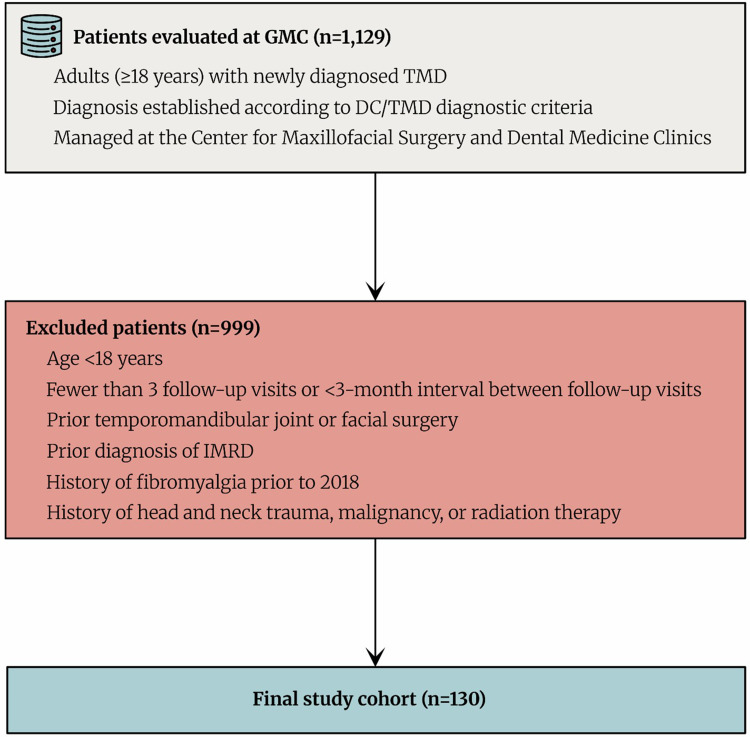
Methods: A retrospective single-center cohort study that included patients between January 1, 2018 and June 30, 2024. Patients ≥ 18 years old with newly diagnosed TMDs according to the TMD diagnostic criteria, who had ≥ 3 follow-up visits at the center for maxillofacial surgery and dental medicine clinics, Galilee medical center, were included.
Results: A total of 1,129 patients presented with TMDs, 130 patients met the inclusion criteria, of whom 114 (88%) were females. The most common temporomandibular joint (TMJ) symptoms were pain and click sounds in 128 (98.5%) and 24 (18.5%) of patients, respectively. Out of 130 patients with TMDs, 3 patients (2.3%) were diagnosed with IMRD (2 with rheumatoid arthritis (RA) (1.5%), and 1 with familial Mediterranean fever (0.8%)). The median follow-up was 39.9 months (IQR 29.1-51.6), and all patients contributed a total of 431.4 person-years at risk. The incidence rate for IMRD in patients with TMDs in our study was 695.4 per 100,000-person year, and for RA in particular was 463.6 per 100,000-person year None of the evaluated risk factors, including gender, TMJ pain, or other joints pain showed a significant association with the subsequent development of IMRD.
Conclusion: In this small retrospective cohort, patients with TMDs have higher incidence of IMRD compared to estimated incidence in the general population, especially RA.





 京公网安备 11010802042870号
京ICP备2023020795号-1
京公网安备 11010802042870号
京ICP备2023020795号-1
 分享
分享
 求助内容:
求助内容: 应助结果提醒方式:
 扫码关注我们