Libin Yang , Xunshang Shi , Chenyu Gao , Shuai Wu , Qinghong Liu , Xiaolin Zheng , Zhiying Feng , Yan Ding , Yanchao wang , Songtao Xiao
{"title":"A predictive dynamics simulation for the separation of lithium isotope through oriented defective graphene with electrochemical pumping","authors":"Libin Yang , Xunshang Shi , Chenyu Gao , Shuai Wu , Qinghong Liu , Xiaolin Zheng , Zhiying Feng , Yan Ding , Yanchao wang , Songtao Xiao","doi":"10.1016/j.fusengdes.2026.115799","DOIUrl":null,"url":null,"abstract":"<div><div>The separation of lithium isotopes is crucial for the advancement of nuclear energy technology. Electrochemical pumping through two-dimensional membranes with a quantum sieving effect offers significant advantages over conventional methods such as chemical exchange and solvent extraction for separating lithium isotope ions. This study employs molecular dynamics simulations to investigate the permeation mechanism of lithium isotope ions through oriented defective graphene under an electric field and to determine the kinetic isotope effect (KIE). Simulation results reveal that, under an applied electric field, lithium ions gain sufficient kinetic energy to penetrate through electron cloud cavities formed by carbon rings with single or double vacancy defects, whereas pristine graphene effectively blocks their permeation. Further analyses of electron cloud density, transition state search, and energy barrier calculations confirm that lithium isotope ions can traverse the membrane at specific charge densities. The calculated single-stage separation factor for lithium isotopes using single-vacancy defective graphene reaches up to 1.22, which is significantly higher than that achieved by traditional separation methods. Moreover, the separation factor is demonstrated to be directly correlated with the electron cloud density of the carbon rings constituting the defect sites in graphene.</div></div>","PeriodicalId":55133,"journal":{"name":"Fusion Engineering and Design","volume":"229 ","pages":"Article 115799"},"PeriodicalIF":2.0000,"publicationDate":"2026-08-01","publicationTypes":"Journal Article","fieldsOfStudy":null,"isOpenAccess":false,"openAccessPdf":"","citationCount":"0","resultStr":null,"platform":"Semanticscholar","paperid":null,"PeriodicalName":"Fusion Engineering and Design","FirstCategoryId":"5","ListUrlMain":"https://www.sciencedirect.com/science/article/pii/S0920379626001869","RegionNum":3,"RegionCategory":"工程技术","ArticlePicture":[],"TitleCN":null,"AbstractTextCN":null,"PMCID":null,"EPubDate":"2026/5/7 0:00:00","PubModel":"Epub","JCR":"Q1","JCRName":"NUCLEAR SCIENCE & TECHNOLOGY","Score":null,"Total":0}
引用次数: 0
Abstract
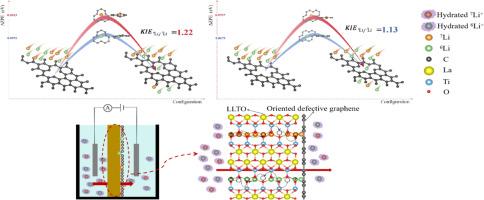
The separation of lithium isotopes is crucial for the advancement of nuclear energy technology. Electrochemical pumping through two-dimensional membranes with a quantum sieving effect offers significant advantages over conventional methods such as chemical exchange and solvent extraction for separating lithium isotope ions. This study employs molecular dynamics simulations to investigate the permeation mechanism of lithium isotope ions through oriented defective graphene under an electric field and to determine the kinetic isotope effect (KIE). Simulation results reveal that, under an applied electric field, lithium ions gain sufficient kinetic energy to penetrate through electron cloud cavities formed by carbon rings with single or double vacancy defects, whereas pristine graphene effectively blocks their permeation. Further analyses of electron cloud density, transition state search, and energy barrier calculations confirm that lithium isotope ions can traverse the membrane at specific charge densities. The calculated single-stage separation factor for lithium isotopes using single-vacancy defective graphene reaches up to 1.22, which is significantly higher than that achieved by traditional separation methods. Moreover, the separation factor is demonstrated to be directly correlated with the electron cloud density of the carbon rings constituting the defect sites in graphene.
期刊介绍:
The journal accepts papers about experiments (both plasma and technology), theory, models, methods, and designs in areas relating to technology, engineering, and applied science aspects of magnetic and inertial fusion energy. Specific areas of interest include: MFE and IFE design studies for experiments and reactors; fusion nuclear technologies and materials, including blankets and shields; analysis of reactor plasmas; plasma heating, fuelling, and vacuum systems; drivers, targets, and special technologies for IFE, controls and diagnostics; fuel cycle analysis and tritium reprocessing and handling; operations and remote maintenance of reactors; safety, decommissioning, and waste management; economic and environmental analysis of components and systems.





 京公网安备 11010802042870号
京ICP备2023020795号-1
京公网安备 11010802042870号
京ICP备2023020795号-1
 分享
分享
 求助内容:
求助内容: 应助结果提醒方式:
 扫码关注我们