A A Saleh, S M El-Hefnawy, Z A Kasemy, A A Alhagaa, M Z Nooh, E S Arafat
{"title":"Mi-RNA-93 and Mi-RNA-152 in the Diagnosis of Type 2 Diabetes and Diabetic Retinopathy.","authors":"A A Saleh, S M El-Hefnawy, Z A Kasemy, A A Alhagaa, M Z Nooh, E S Arafat","doi":"10.3389/bjbs.2021.10192","DOIUrl":null,"url":null,"abstract":"<p><p><b>Background and Aim:</b> Diabetes mellitus (DM) is a chronic disorder with diabetic retinopathy (DR) as one of its main microvascular outcomes, being a prime cause of vision loss. Dysregulation of microRNAs (miRNAs) has been associated with some diabetic microvascular complications such as diabetic retinopathy. This hypothesised changes in the serum of miR-93 and miR-152 in diabetes and diabetic retinopathy. <b>Methods:</b> The study cohort consisted of 80 healthy volunteers, 80 type 2 diabetic patients, and 80 diabetic retinopathy patients, of whom 40 had proliferative (PDR) and 40 non-proliferative retinopathy (NPDR). Serum fasting and 2-hour postprandial glucose (2hPP), glycated haemoglobin (HbA1c), fasting insulin, and HOMA-IR were evaluated by routine methods, miR-93 and miR-152 expression by quantitative real-time PCR. <b>Results:</b> FBG, 2hPP, fasting insulin, HOMA-IR, and miR-152 showed an increasing trend across groups while miR-93 showed a decreasing trend (all <i>p</i> < 0.001). Binary logistic regression analysis for prediction of DR found that the most significant were miR-152 (OR 1.37, 95% CI: 1.18-1.58, <0.001), BMI (1.13, [1.07-1.31], <i>p</i> = 0.004), duration of disease (1.29 [1.04-1.6] <i>p</i> = 0.018), and miR-152 (0.01, [0.0-0.47] <i>p</i> = 0.019). The most significant predictors of PDR were miR-152 (OR = 1.47, 95% CI: 1.12-1.92, <i>p</i> = 0.005), HOMA-IR (2.66 [1.30-5.45] <i>p</i> = 0.007), and miR-93 (0.25 [0.07-0.86] <i>p</i> = 0.028). <b>Conclusion:</b> MiR-93 and miR-152 can differentiate patients with diabetes and those with DR. Both miRNAs might be potential biomarkers for diabetes and diabetic retinopathy, and specifically for proliferative diabetic retinopathy.</p>","PeriodicalId":2,"journal":{"name":"ACS Applied Bio Materials","volume":" ","pages":"10192"},"PeriodicalIF":5.6000,"publicationDate":"2022-01-21","publicationTypes":"Journal Article","fieldsOfStudy":null,"isOpenAccess":false,"openAccessPdf":"https://www.ncbi.nlm.nih.gov/pmc/articles/PMC8915732/pdf/","citationCount":"0","resultStr":null,"platform":"Semanticscholar","paperid":null,"PeriodicalName":"ACS Applied Bio Materials","FirstCategoryId":"1085","ListUrlMain":"https://doi.org/10.3389/bjbs.2021.10192","RegionNum":0,"RegionCategory":null,"ArticlePicture":[],"TitleCN":null,"AbstractTextCN":null,"PMCID":null,"EPubDate":"2022/1/1 0:00:00","PubModel":"eCollection","JCR":"Q2","JCRName":"MATERIALS SCIENCE, BIOMATERIALS","Score":null,"Total":0}
引用次数: 0
Abstract
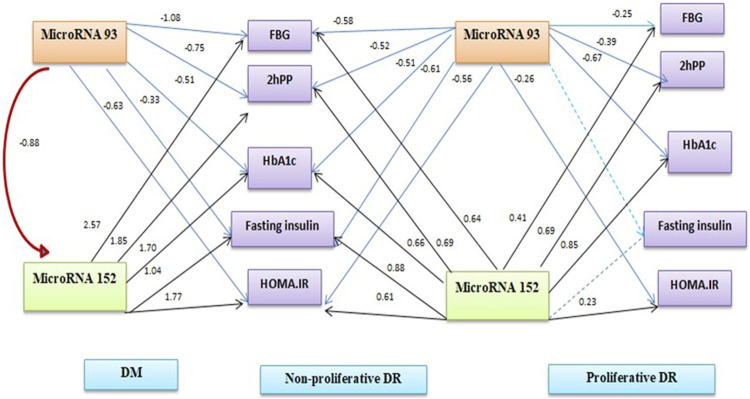
Background and Aim: Diabetes mellitus (DM) is a chronic disorder with diabetic retinopathy (DR) as one of its main microvascular outcomes, being a prime cause of vision loss. Dysregulation of microRNAs (miRNAs) has been associated with some diabetic microvascular complications such as diabetic retinopathy. This hypothesised changes in the serum of miR-93 and miR-152 in diabetes and diabetic retinopathy. Methods: The study cohort consisted of 80 healthy volunteers, 80 type 2 diabetic patients, and 80 diabetic retinopathy patients, of whom 40 had proliferative (PDR) and 40 non-proliferative retinopathy (NPDR). Serum fasting and 2-hour postprandial glucose (2hPP), glycated haemoglobin (HbA1c), fasting insulin, and HOMA-IR were evaluated by routine methods, miR-93 and miR-152 expression by quantitative real-time PCR. Results: FBG, 2hPP, fasting insulin, HOMA-IR, and miR-152 showed an increasing trend across groups while miR-93 showed a decreasing trend (all p < 0.001). Binary logistic regression analysis for prediction of DR found that the most significant were miR-152 (OR 1.37, 95% CI: 1.18-1.58, <0.001), BMI (1.13, [1.07-1.31], p = 0.004), duration of disease (1.29 [1.04-1.6] p = 0.018), and miR-152 (0.01, [0.0-0.47] p = 0.019). The most significant predictors of PDR were miR-152 (OR = 1.47, 95% CI: 1.12-1.92, p = 0.005), HOMA-IR (2.66 [1.30-5.45] p = 0.007), and miR-93 (0.25 [0.07-0.86] p = 0.028). Conclusion: MiR-93 and miR-152 can differentiate patients with diabetes and those with DR. Both miRNAs might be potential biomarkers for diabetes and diabetic retinopathy, and specifically for proliferative diabetic retinopathy.
期刊介绍:
ACS Applied Bio Materials is an interdisciplinary journal publishing original research covering all aspects of biomaterials and biointerfaces including and beyond the traditional biosensing, biomedical and therapeutic applications.
The journal is devoted to reports of new and original experimental and theoretical research of an applied nature that integrates knowledge in the areas of materials, engineering, physics, bioscience, and chemistry into important bio applications. The journal is specifically interested in work that addresses the relationship between structure and function and assesses the stability and degradation of materials under relevant environmental and biological conditions.





 京公网安备 11010802042870号
京ICP备2023020795号-1
 分享
 求助内容:
 应助结果提醒方式:
 扫码关注我们