{"title":"半盐水合物驱动的无充电热再生电化学循环操作温度的调整","authors":"Yohei Matsui and Yuki Maeda","doi":"10.1039/D5SE01681A","DOIUrl":null,"url":null,"abstract":"<p >Electrolytes with a strong temperature dependence of the redox potential, denoted as the temperature coefficient, are required to increase the voltage of thermo-electrochemical devices. In our previous study, we revealed that the temperature coefficient of ferrocyanide/ferricyanide redox couple ([Fe(CN)<small><sub>6</sub></small>]<small><sup>4−/3−</sup></small>) dramatically increases in a mixture of water and tetrabutylammonium fluoride (TBAF) owing to the formation of semiclathrate hydrate (SCH). However, the temperature range in which a high temperature coefficient is obtained is limited to the vicinity of the SCH formation temperature. In this study, we demonstrate that this temperature range can be adjusted using organic salts that provide different SCH formation temperatures, such as tetrabutylammonium chloride and tetrabutylphosphonium chloride (TBPC). Replacing the organic salt affects both the temperature range and magnitude of the temperature coefficient. The calculation using the developed model to evaluate the contribution of SCH formation revealed the origin of the difference in temperature coefficient, such as the dependence of redox potential of [Fe(CN)<small><sub>6</sub></small>]<small><sup>4−/3−</sup></small> on organic salt concentration in the liquid phase, and the temperature dependence of organic salt concentration in the liquid phase. Furthermore, we assembled a thermo-electrochemical device for a charging-free thermally regenerative electrochemical cycle using electrolytes with different organic salts. The devices using different organic salts were operated in distinct temperature ranges: 292–297 K for the TBAF-based system and 276–280 K for the TBPC-based system. This study expands the applicability of high-voltage thermo-electrochemical devices driven by the SCH formation.</p>","PeriodicalId":104,"journal":{"name":"Sustainable Energy & Fuels","volume":" 7","pages":" 1719-1727"},"PeriodicalIF":4.6000,"publicationDate":"2026-03-04","publicationTypes":"Journal Article","fieldsOfStudy":null,"isOpenAccess":false,"openAccessPdf":"","citationCount":"0","resultStr":"{\"title\":\"Tuning operation temperature of charging-free thermally regenerative electrochemical cycles driven by semiclathrate hydrate formation\",\"authors\":\"Yohei Matsui and Yuki Maeda\",\"doi\":\"10.1039/D5SE01681A\",\"DOIUrl\":null,\"url\":null,\"abstract\":\"<p >Electrolytes with a strong temperature dependence of the redox potential, denoted as the temperature coefficient, are required to increase the voltage of thermo-electrochemical devices. In our previous study, we revealed that the temperature coefficient of ferrocyanide/ferricyanide redox couple ([Fe(CN)<small><sub>6</sub></small>]<small><sup>4−/3−</sup></small>) dramatically increases in a mixture of water and tetrabutylammonium fluoride (TBAF) owing to the formation of semiclathrate hydrate (SCH). However, the temperature range in which a high temperature coefficient is obtained is limited to the vicinity of the SCH formation temperature. In this study, we demonstrate that this temperature range can be adjusted using organic salts that provide different SCH formation temperatures, such as tetrabutylammonium chloride and tetrabutylphosphonium chloride (TBPC). Replacing the organic salt affects both the temperature range and magnitude of the temperature coefficient. The calculation using the developed model to evaluate the contribution of SCH formation revealed the origin of the difference in temperature coefficient, such as the dependence of redox potential of [Fe(CN)<small><sub>6</sub></small>]<small><sup>4−/3−</sup></small> on organic salt concentration in the liquid phase, and the temperature dependence of organic salt concentration in the liquid phase. Furthermore, we assembled a thermo-electrochemical device for a charging-free thermally regenerative electrochemical cycle using electrolytes with different organic salts. The devices using different organic salts were operated in distinct temperature ranges: 292–297 K for the TBAF-based system and 276–280 K for the TBPC-based system. This study expands the applicability of high-voltage thermo-electrochemical devices driven by the SCH formation.</p>\",\"PeriodicalId\":104,\"journal\":{\"name\":\"Sustainable Energy & Fuels\",\"volume\":\" 7\",\"pages\":\" 1719-1727\"},\"PeriodicalIF\":4.6000,\"publicationDate\":\"2026-03-04\",\"publicationTypes\":\"Journal Article\",\"fieldsOfStudy\":null,\"isOpenAccess\":false,\"openAccessPdf\":\"\",\"citationCount\":\"0\",\"resultStr\":null,\"platform\":\"Semanticscholar\",\"paperid\":null,\"PeriodicalName\":\"Sustainable Energy & Fuels\",\"FirstCategoryId\":\"88\",\"ListUrlMain\":\"https://pubs.rsc.org/en/content/articlelanding/2026/se/d5se01681a\",\"RegionNum\":3,\"RegionCategory\":\"材料科学\",\"ArticlePicture\":[],\"TitleCN\":null,\"AbstractTextCN\":null,\"PMCID\":null,\"EPubDate\":\"\",\"PubModel\":\"\",\"JCR\":\"Q2\",\"JCRName\":\"CHEMISTRY, PHYSICAL\",\"Score\":null,\"Total\":0}","platform":"Semanticscholar","paperid":null,"PeriodicalName":"Sustainable Energy & Fuels","FirstCategoryId":"88","ListUrlMain":"https://pubs.rsc.org/en/content/articlelanding/2026/se/d5se01681a","RegionNum":3,"RegionCategory":"材料科学","ArticlePicture":[],"TitleCN":null,"AbstractTextCN":null,"PMCID":null,"EPubDate":"","PubModel":"","JCR":"Q2","JCRName":"CHEMISTRY, PHYSICAL","Score":null,"Total":0}
Tuning operation temperature of charging-free thermally regenerative electrochemical cycles driven by semiclathrate hydrate formation
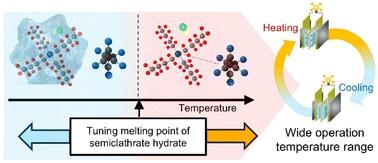
Electrolytes with a strong temperature dependence of the redox potential, denoted as the temperature coefficient, are required to increase the voltage of thermo-electrochemical devices. In our previous study, we revealed that the temperature coefficient of ferrocyanide/ferricyanide redox couple ([Fe(CN)6]4−/3−) dramatically increases in a mixture of water and tetrabutylammonium fluoride (TBAF) owing to the formation of semiclathrate hydrate (SCH). However, the temperature range in which a high temperature coefficient is obtained is limited to the vicinity of the SCH formation temperature. In this study, we demonstrate that this temperature range can be adjusted using organic salts that provide different SCH formation temperatures, such as tetrabutylammonium chloride and tetrabutylphosphonium chloride (TBPC). Replacing the organic salt affects both the temperature range and magnitude of the temperature coefficient. The calculation using the developed model to evaluate the contribution of SCH formation revealed the origin of the difference in temperature coefficient, such as the dependence of redox potential of [Fe(CN)6]4−/3− on organic salt concentration in the liquid phase, and the temperature dependence of organic salt concentration in the liquid phase. Furthermore, we assembled a thermo-electrochemical device for a charging-free thermally regenerative electrochemical cycle using electrolytes with different organic salts. The devices using different organic salts were operated in distinct temperature ranges: 292–297 K for the TBAF-based system and 276–280 K for the TBPC-based system. This study expands the applicability of high-voltage thermo-electrochemical devices driven by the SCH formation.
期刊介绍:
Sustainable Energy & Fuels will publish research that contributes to the development of sustainable energy technologies with a particular emphasis on new and next-generation technologies.





 京公网安备 11010802042870号
京ICP备2023020795号-1
京公网安备 11010802042870号
京ICP备2023020795号-1
 分享
分享
 求助内容:
求助内容: 应助结果提醒方式:
 扫码关注我们